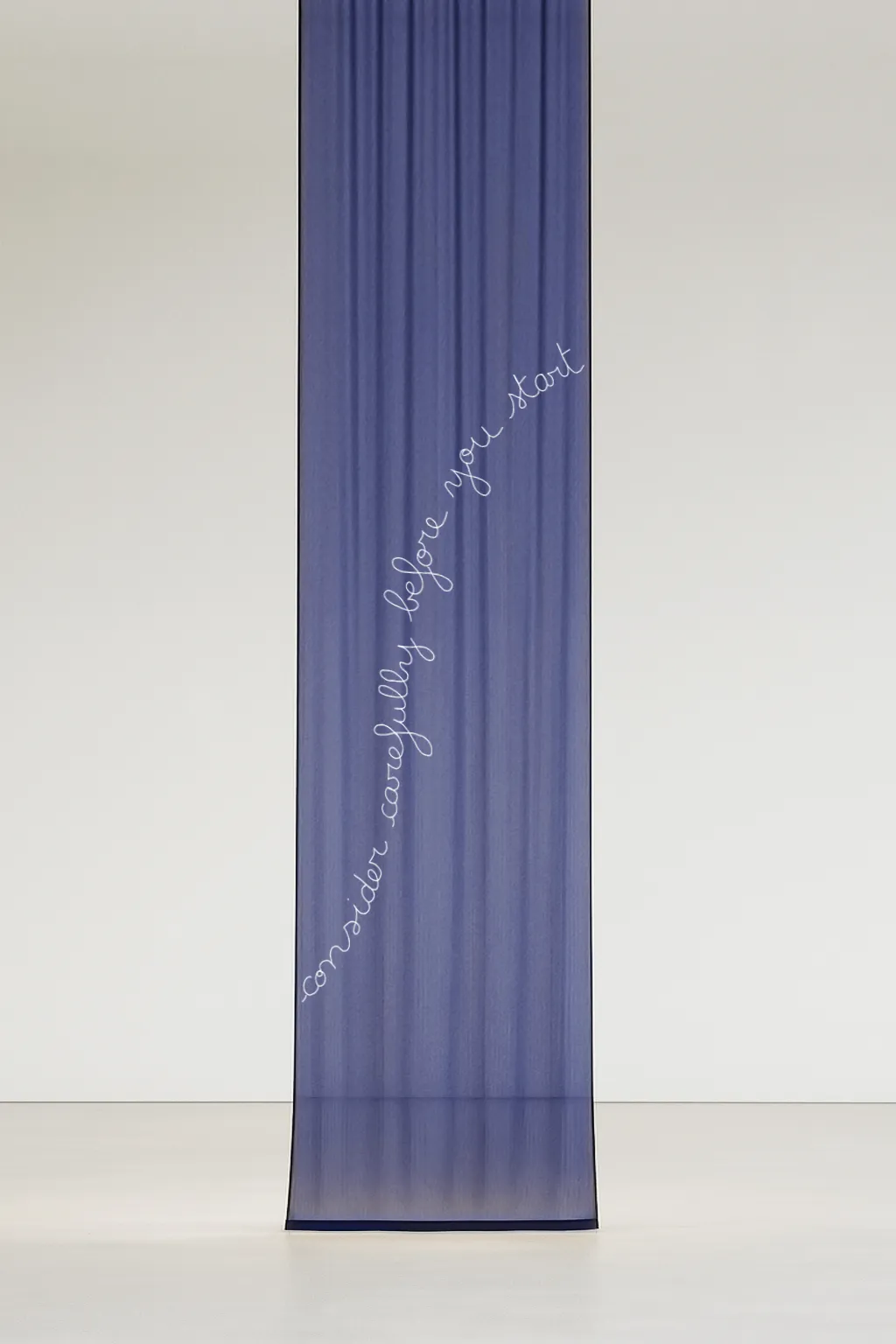
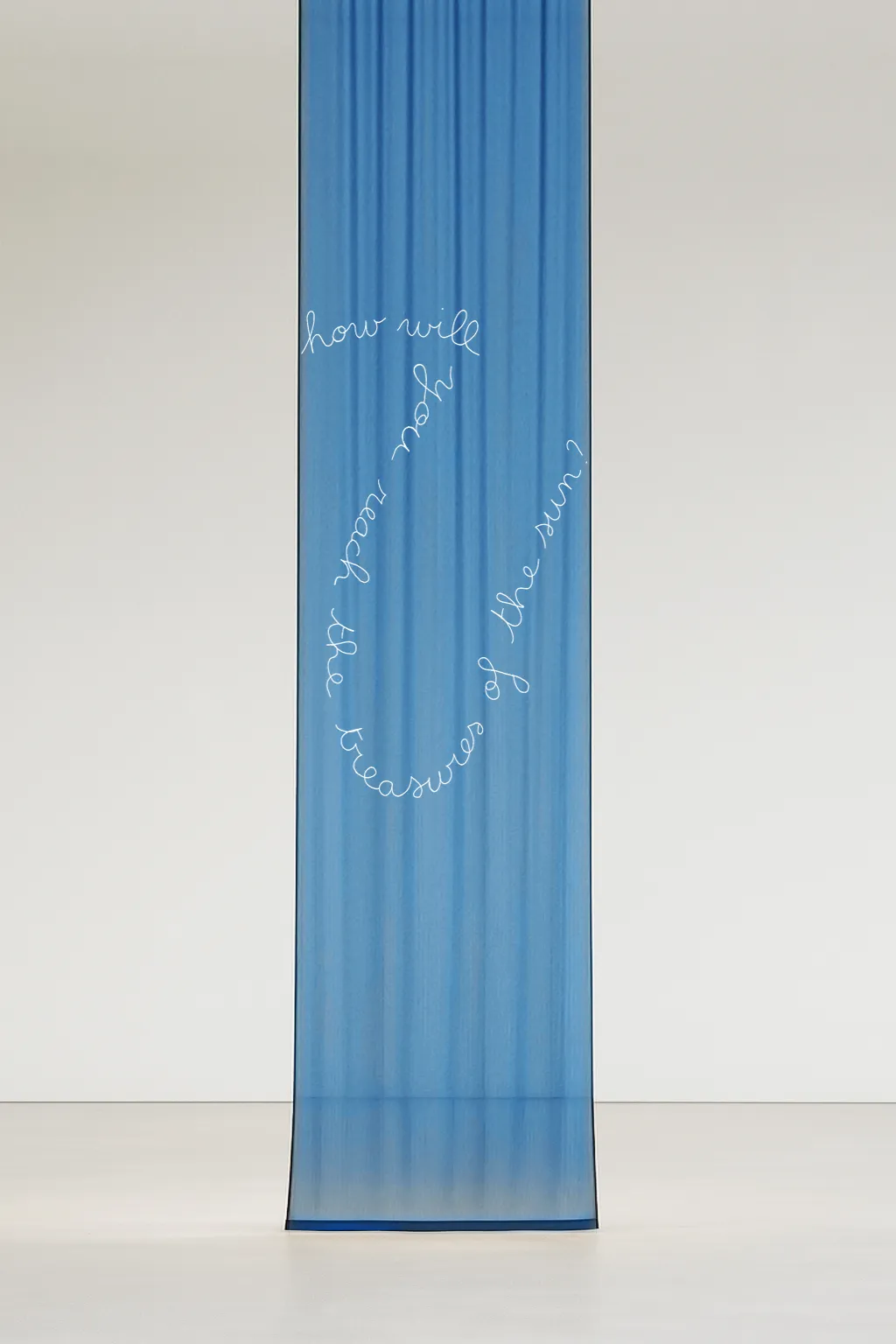
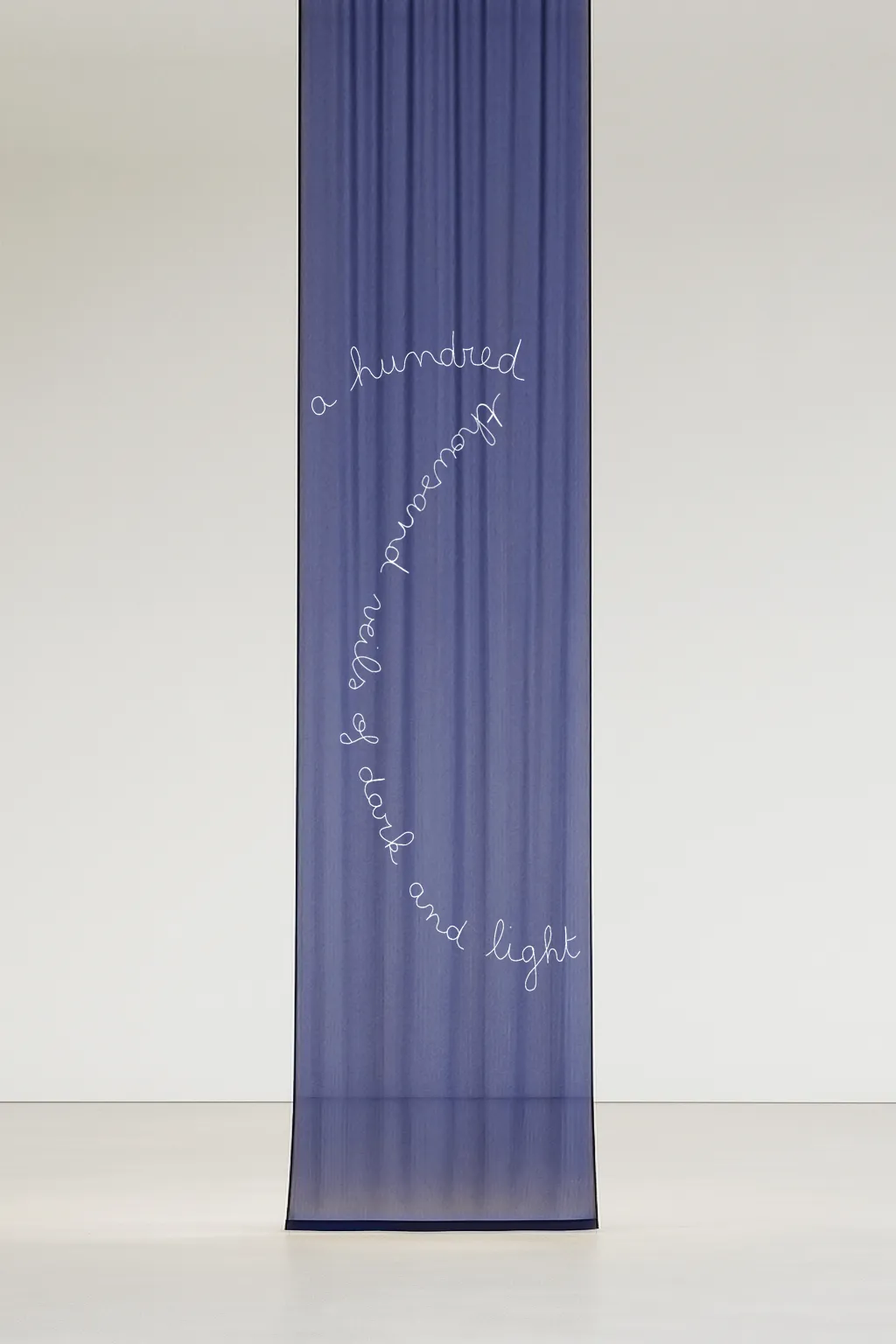
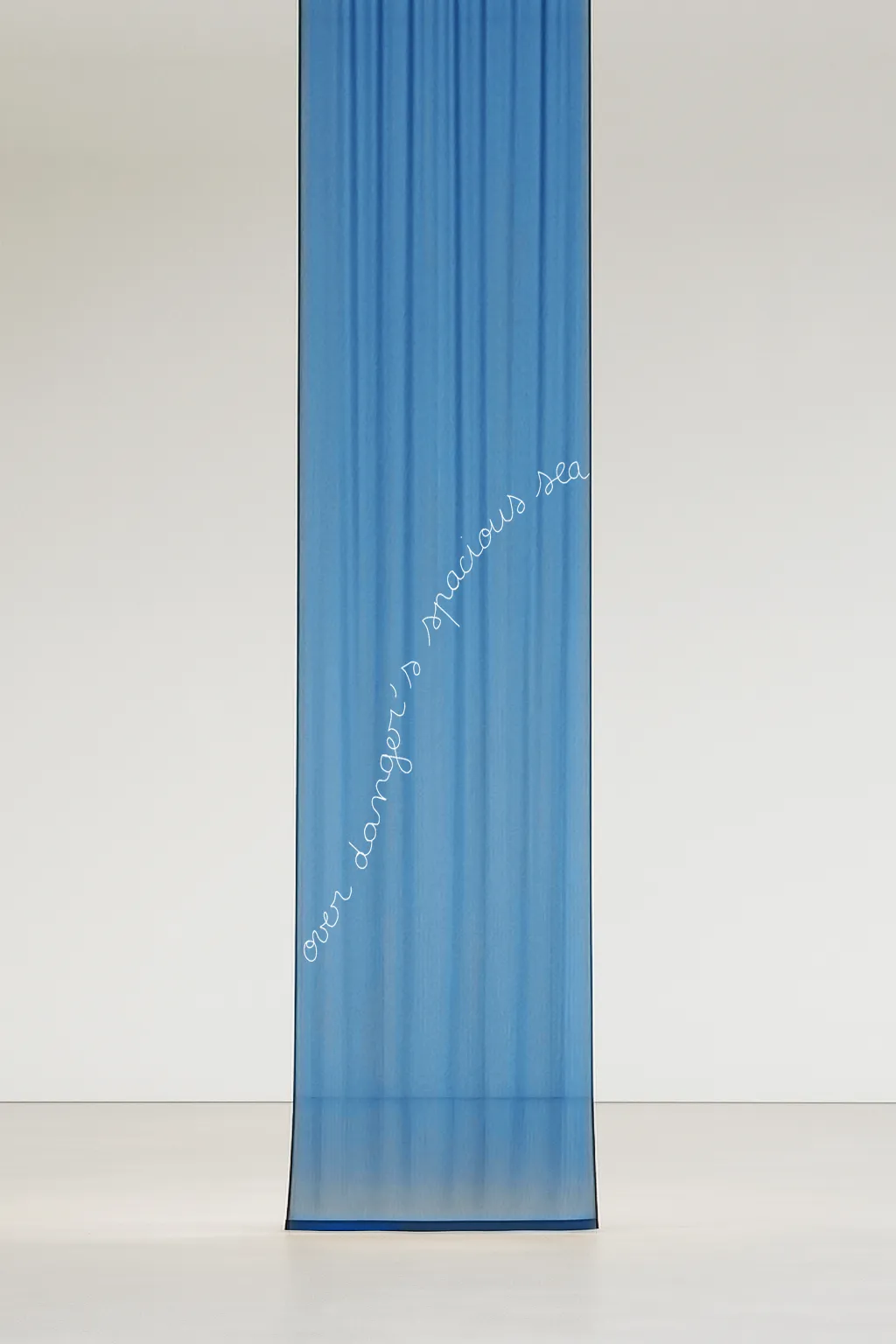
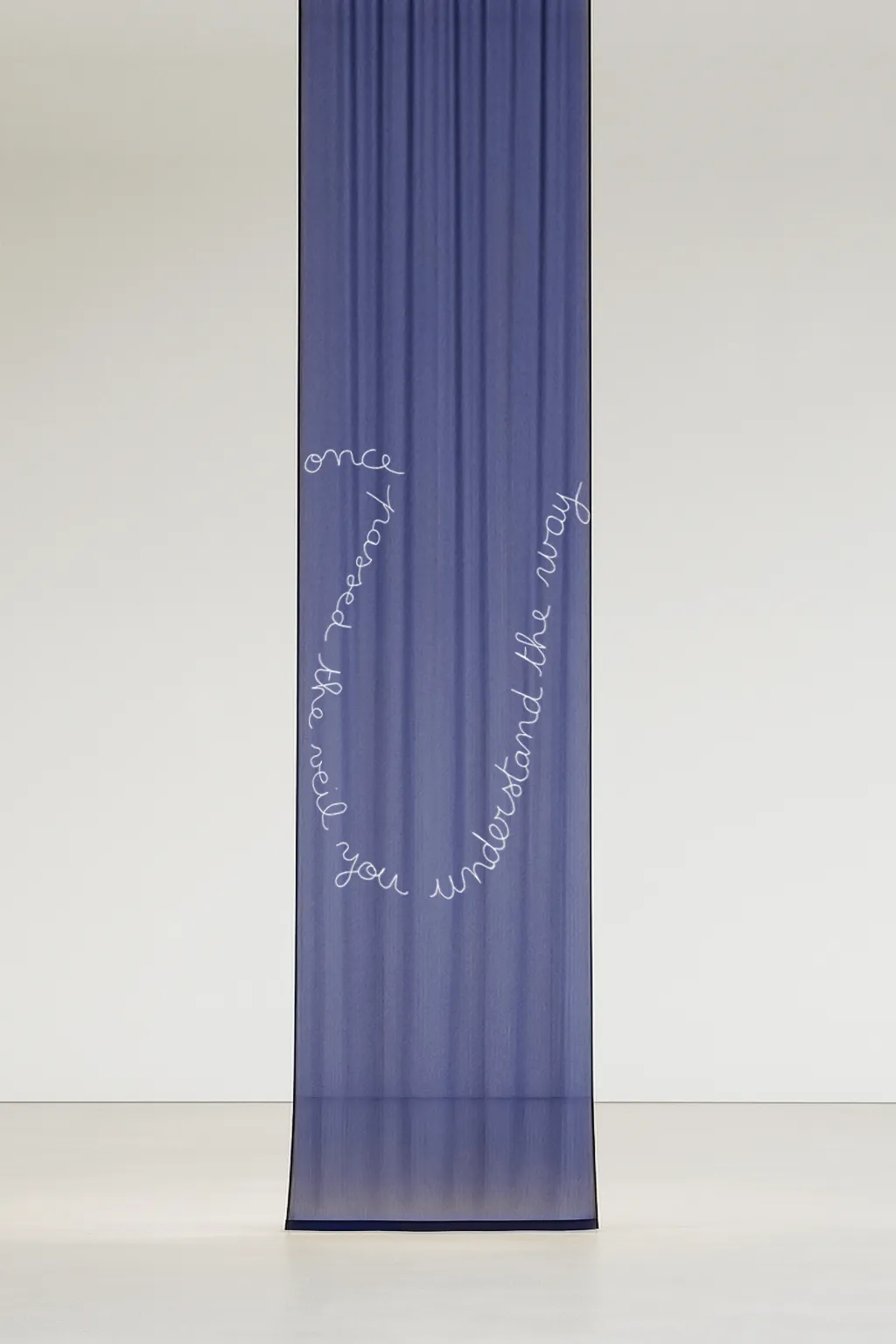
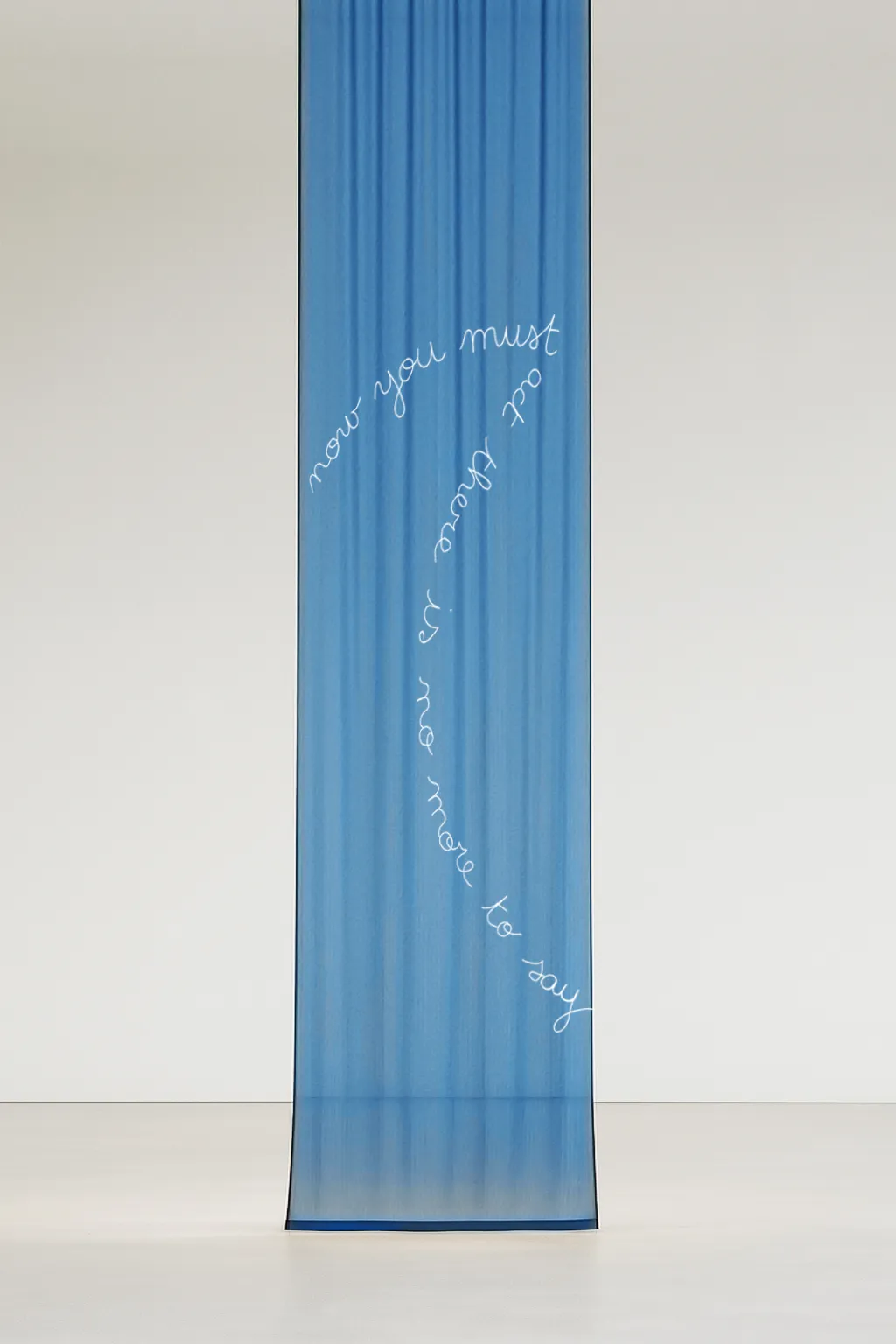
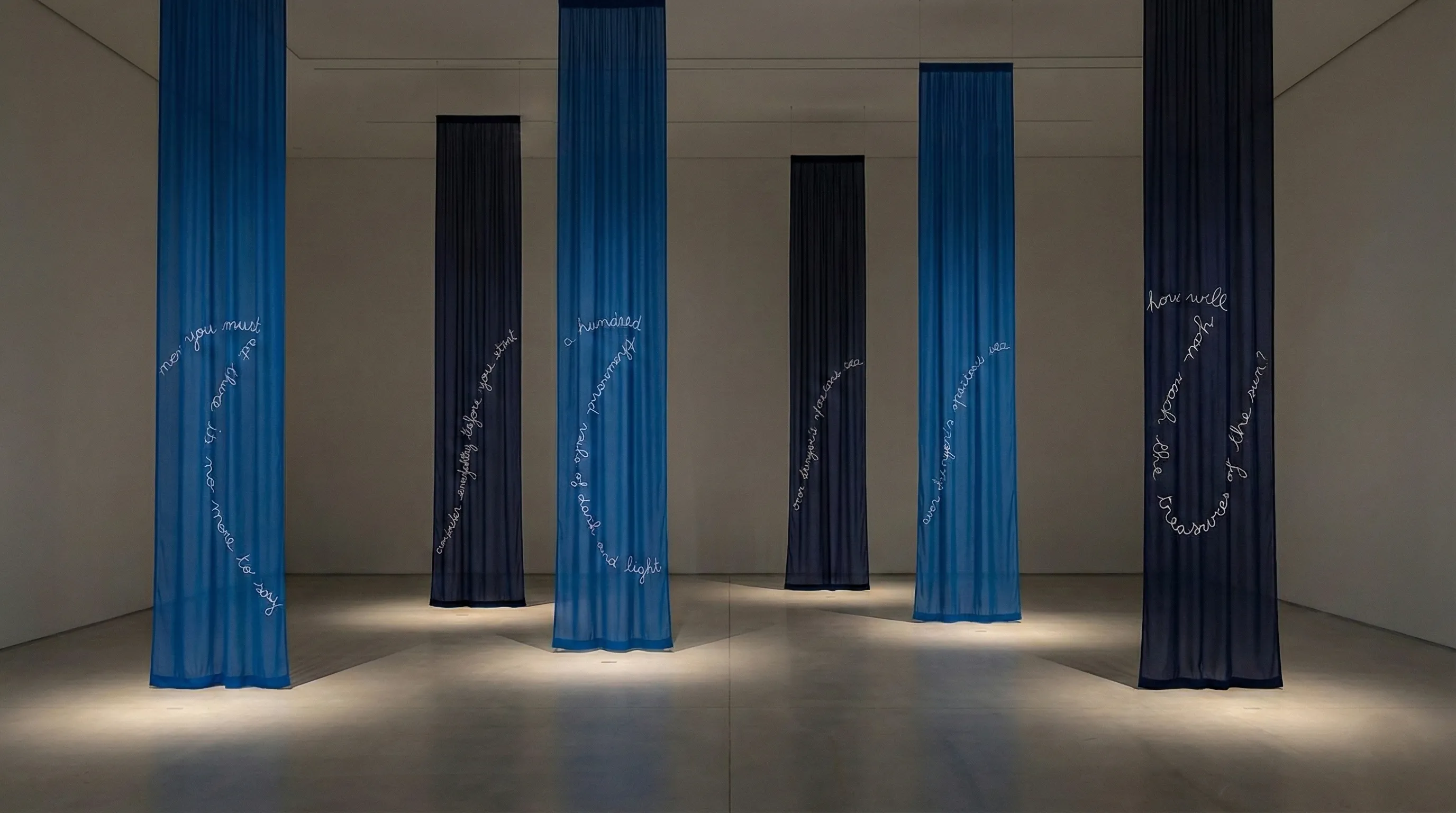
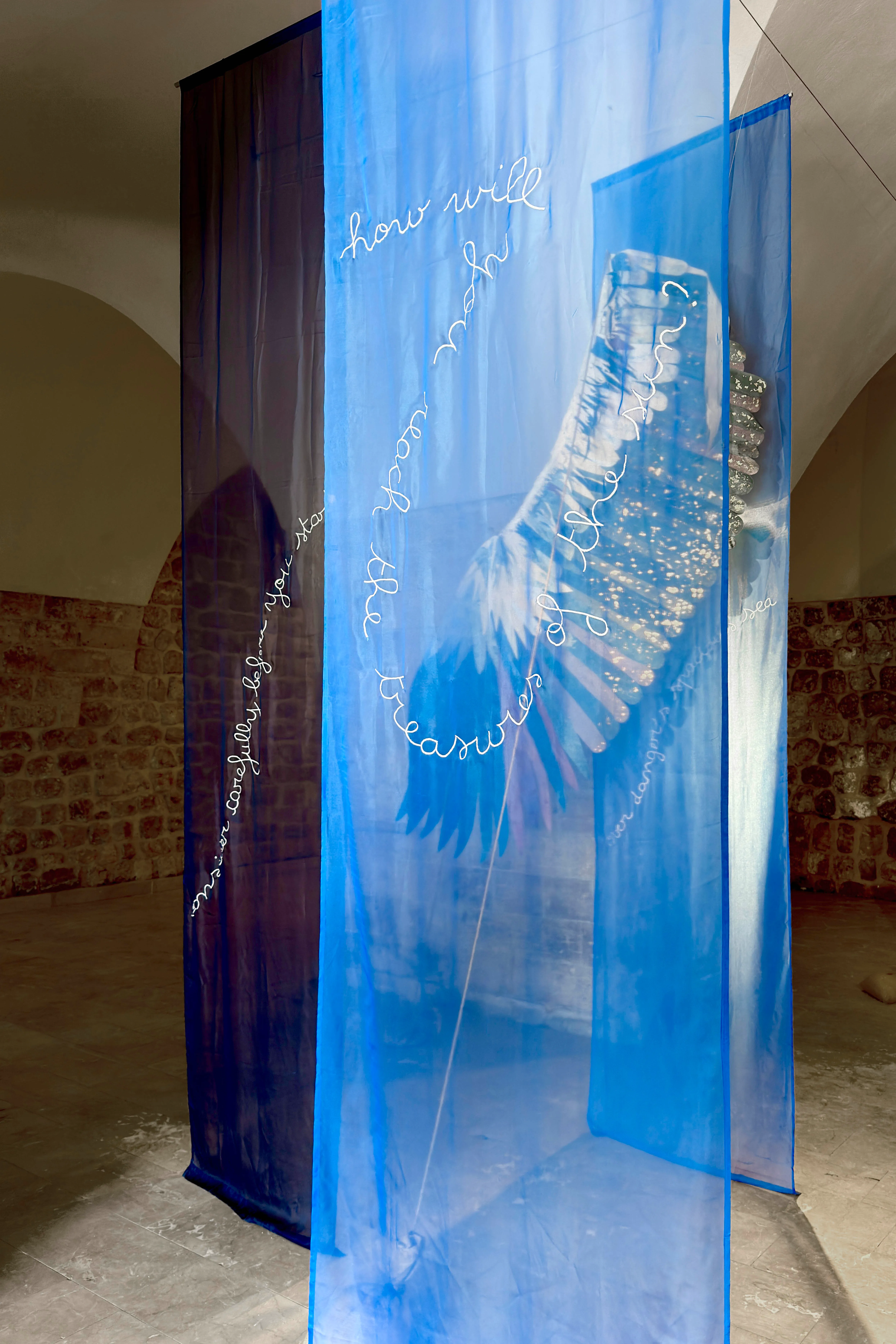
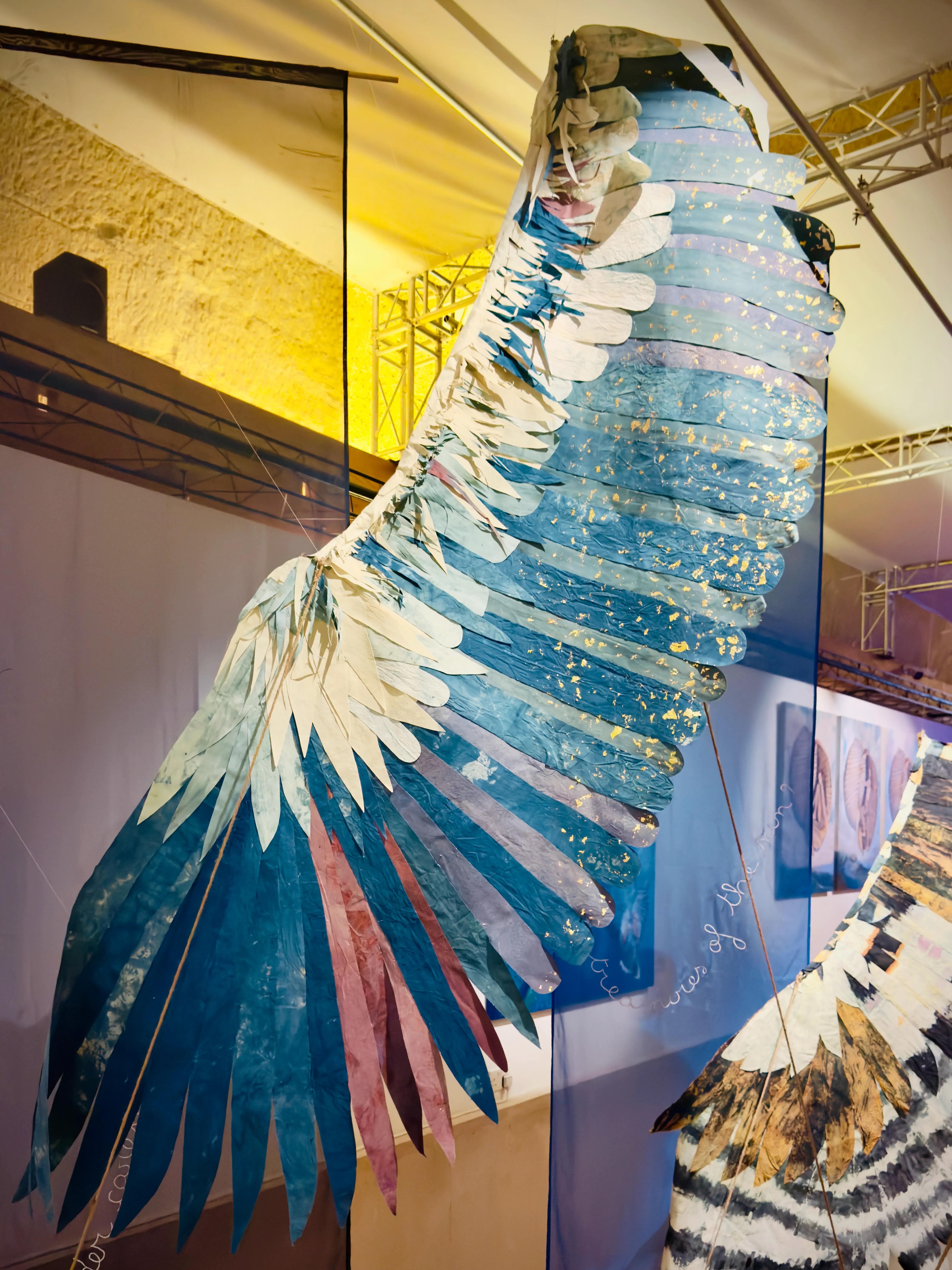
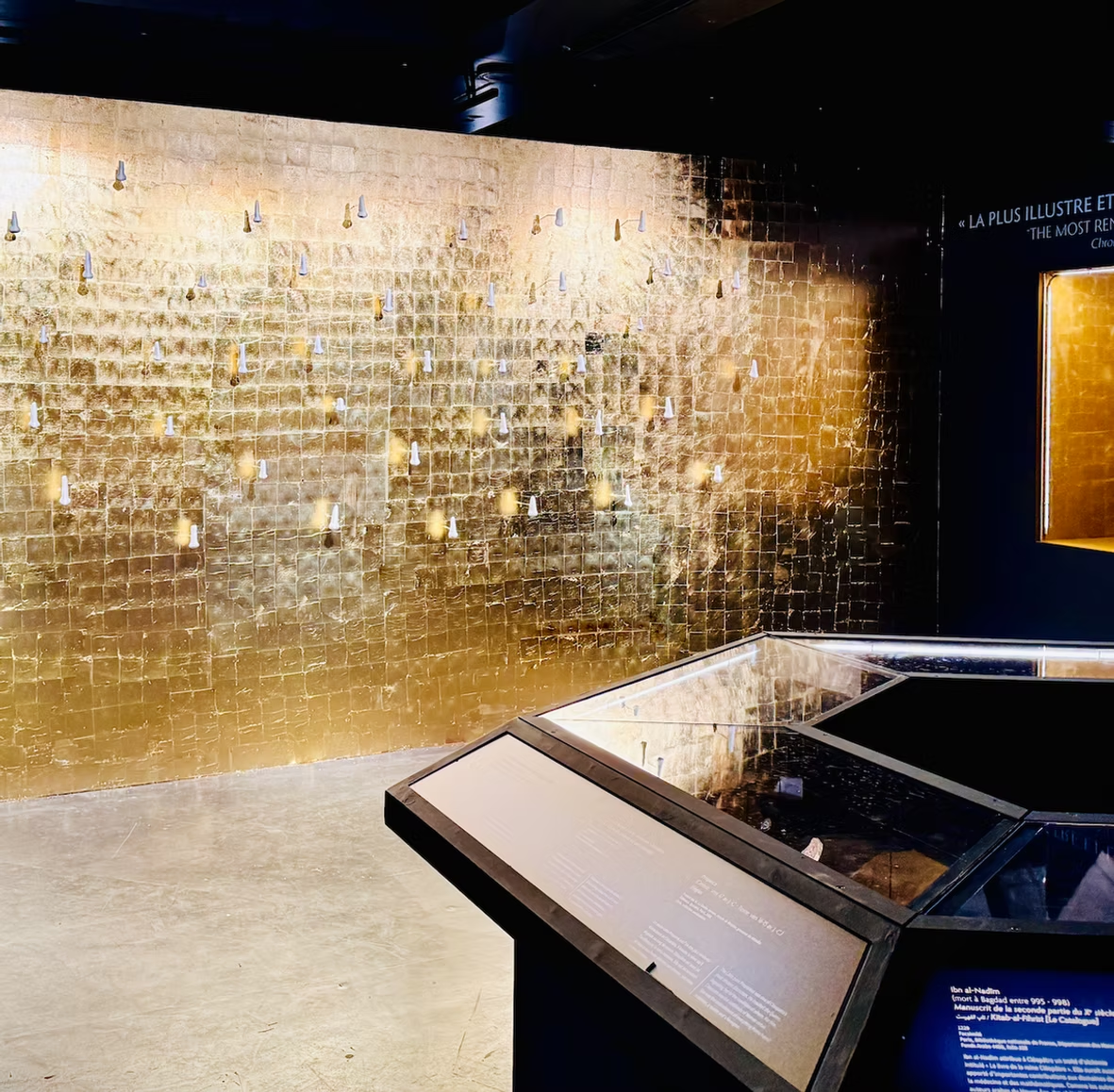
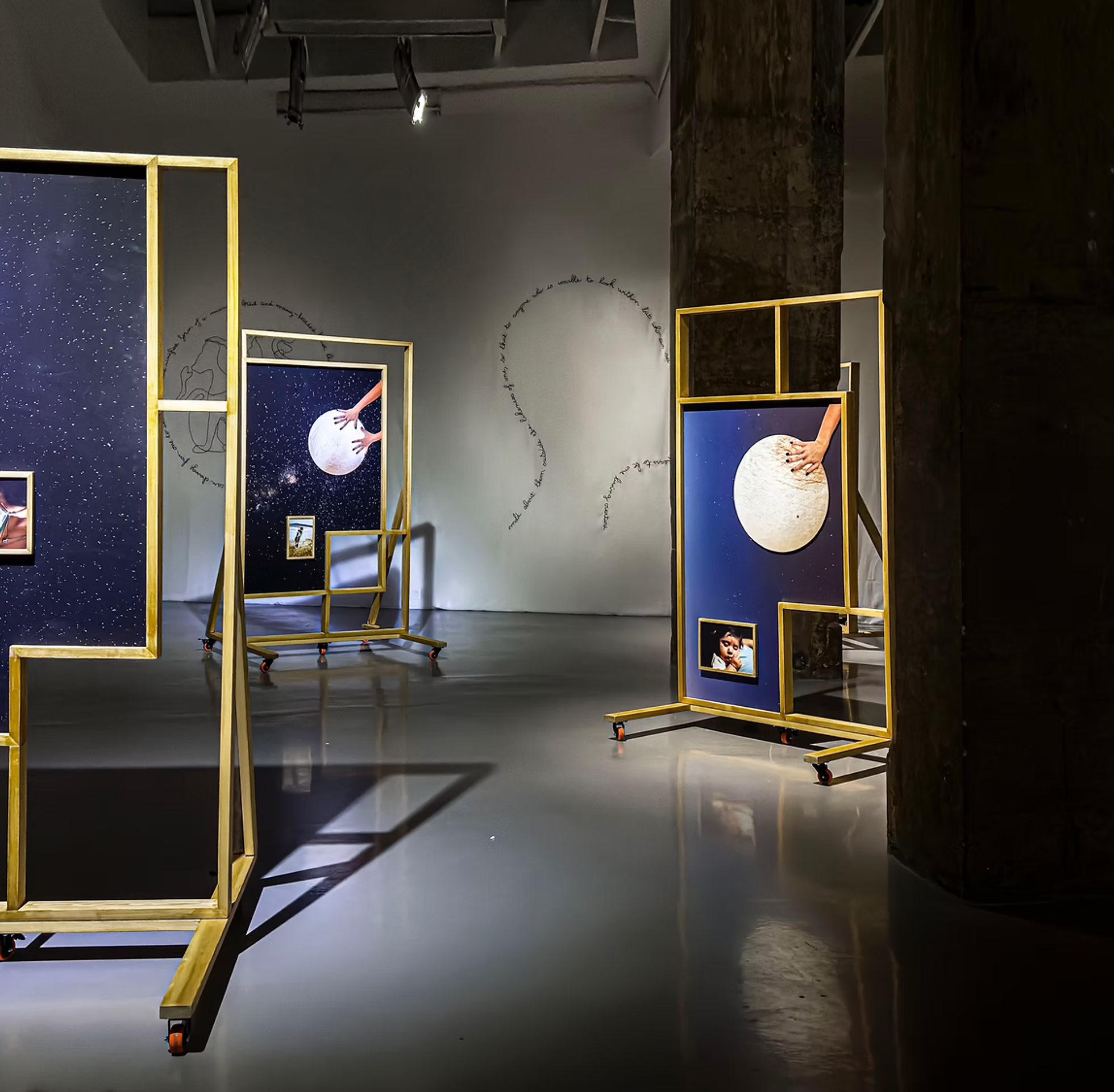
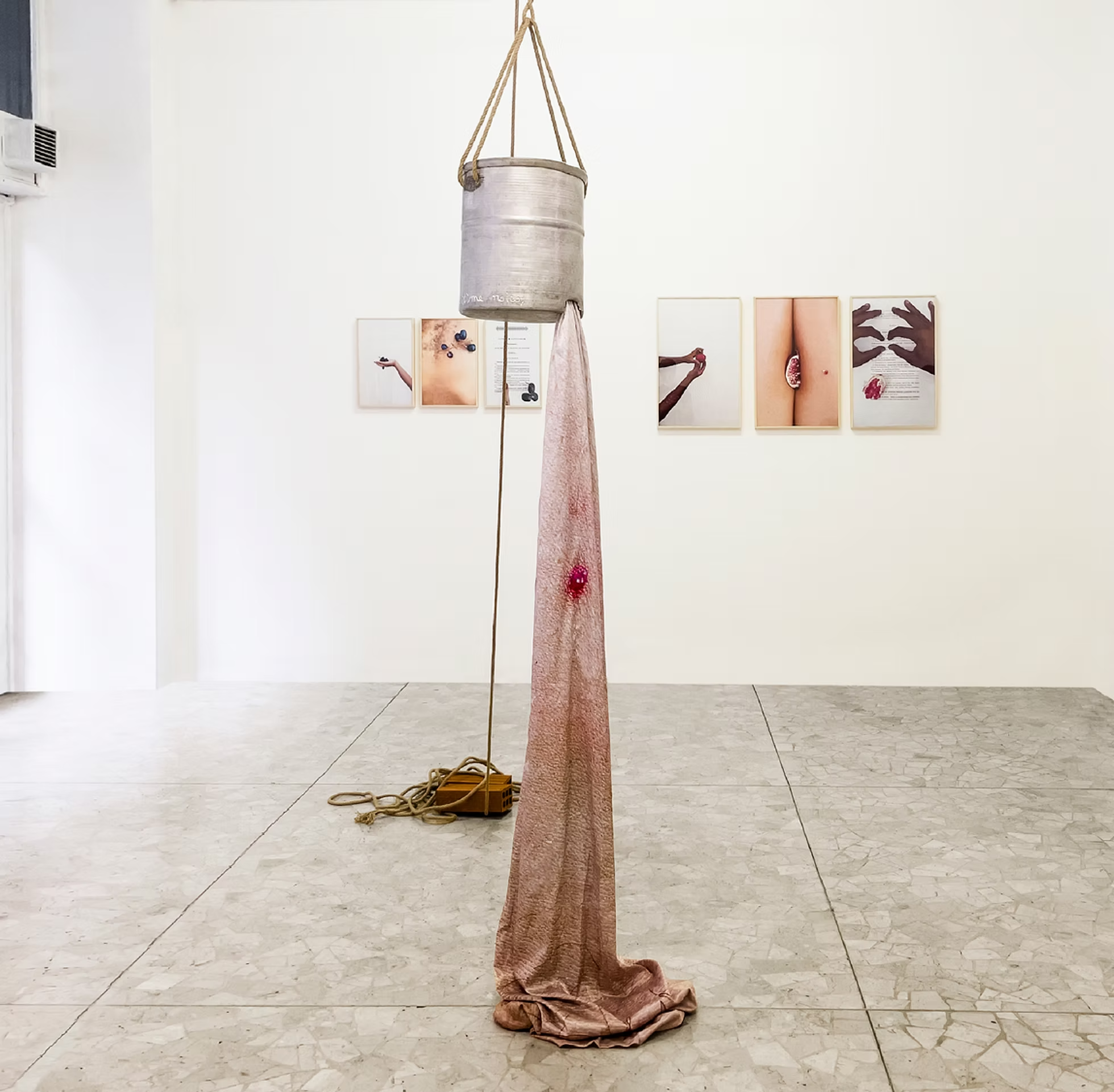
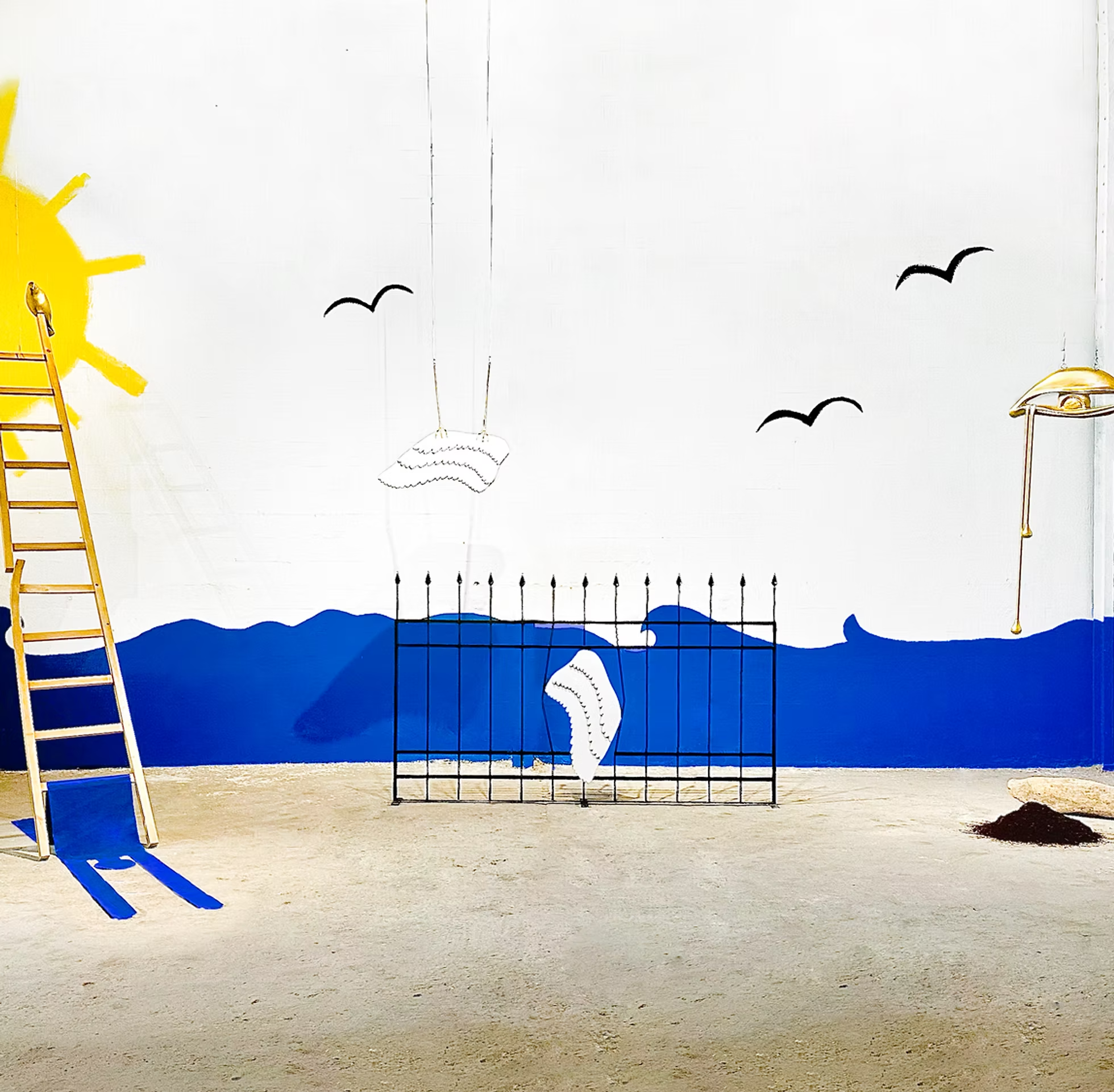
archipeLogos belongs to The Bird, the Thread, and the Open Sea, in which Kosmatopoulos translates Attâr's Conference of the Birds from narrative into space. Attâr's poem describes a spiritual journey shaped by doubt, renunciation and self-discovery — an inner passage as much as an outward voyage. archipeLogos gives this inward journey a landscape.
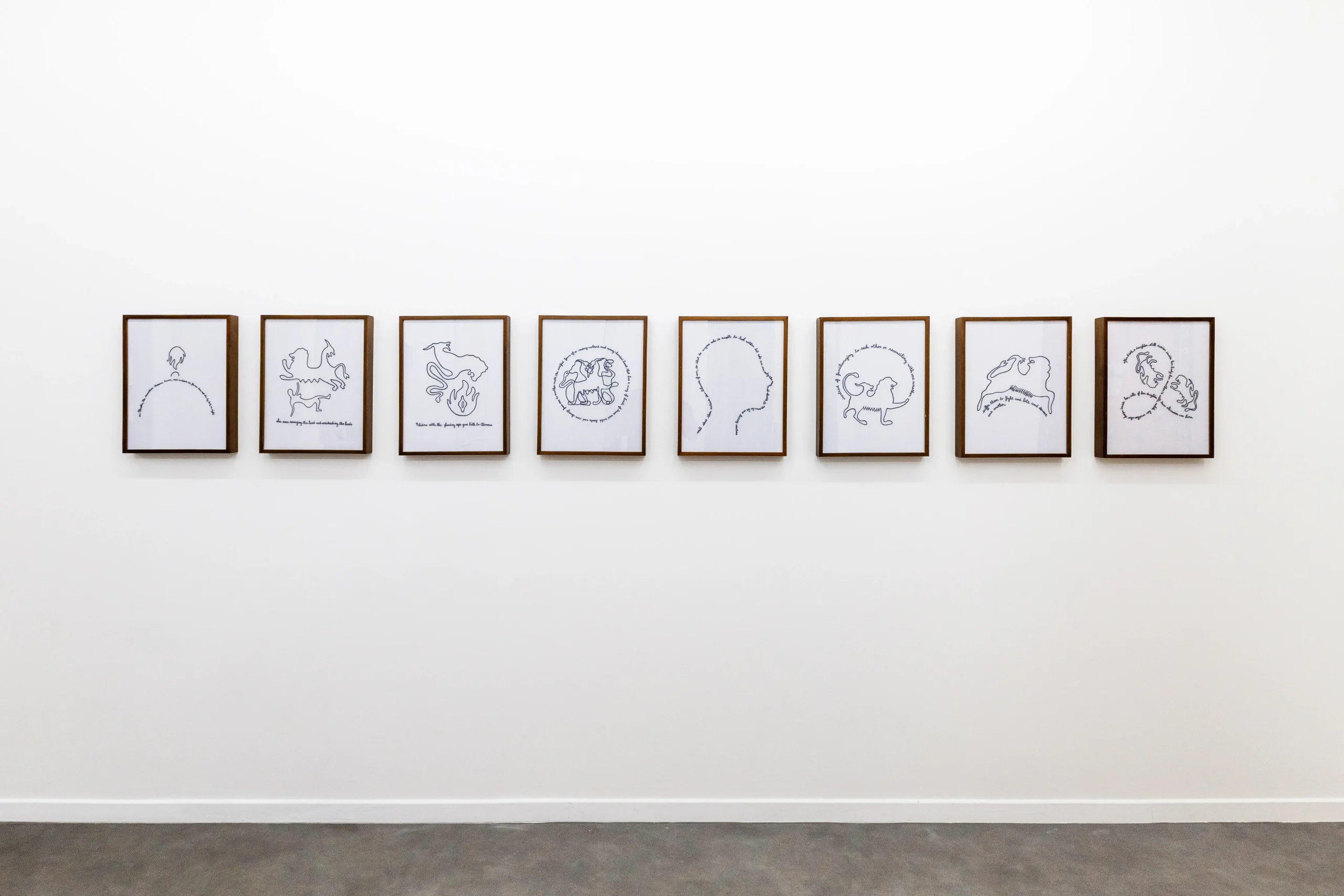
Rather than transcribing the poem, the work extracts six short passages, removes them from their original context, and recomposes them into a new continuous text — a narrative that exists only when the veils are placed side by side. The title fuses archipelago and logos: each veil becomes an island of language within a wider sea of meaning, distinct yet bound to the others by a continuity that cannot be seen all at once.
Separated in space, these fragments no longer function as linear reading. They become islands of language, suspended surfaces where meaning must be navigated rather than received. The embroidered text takes the form of a single continuous wave-like calligram — clean outlines rather than filled shapes — whose form is broken apart and dispersed across the veils: it does not end cleanly within one panel, but is interrupted and continues on the next, so that the same wave travels through the series from surface to surface. Words bend, break and rejoin along its curve, turning writing into movement rather than message.
Each veil operates simultaneously as text, image and threshold. The translucent fabric keeps bodies, shadows and the surrounding space visible through the embroidery, so reading becomes a form of orientation as much as looking. What was once a poem becomes topography — meaning distributed across space, reconstructed through memory rather than sight.
Placed together, the veils reveal a single rewritten passage. Installed apart, they propose a different mode of narrative — one that unfolds through distance, dispersion and delay. archipeLogos does not ask what the poem says, but how meaning behaves when fractured: how a story persists not through coherence, but through the act of searching.
In this series, fragmentation is not loss but method. The work shifts the poem from voice to terrain, from transmission to navigation. Nothing is missing; it is simply elsewhere.