Noli me tangere takes its title from Christ's words to Mary Magdalene after the Resurrection. She recognises him and moves towards him, but the encounter is interrupted by an injunction traditionally translated as "Do not touch me." A body has returned to visibility while remaining inaccessible to the hand.
The Latin phrase carries an important ambiguity. It can be understood not only as "do not touch me," but also as "do not hold on to me." The distinction shifts the meaning of the prohibition. Touch may be a momentary encounter between two bodies; holding seeks to retain the Other, to prevent departure or transform contact into possession.
Kosmatopoulos removes the figures, landscape and narrative action from the biblical scene. No body appears beneath the words and no hand attempts to cross the distance between them. Only the prohibition remains. Detached from the voice that first pronounced it, the sentence is no longer addressed solely to Mary Magdalene. It extends across the wall and meets every person who enters the space.
Its handwritten form gives the command an intimate quality, as though it had been addressed privately by one body to another. Neon, however, belongs equally to the public language of signs, instructions and warnings. The work holds these registers together: a personal boundary becomes a spatial declaration.
The gold-leaf wall recalls the luminous ground of religious icons, but the sacred figure has disappeared from it. Gold no longer surrounds a represented body; it amplifies an absence. The surface reflects the neon until the letters lose their edges and the injunction becomes an atmosphere of light.
This light introduces the work's central contradiction. The words refuse touch, yet the light they emit cannot remain contained. It reaches the gold, spreads across the wall and enters the viewer's space. We cannot grasp it, but we are already placed within its effects.
The wall intensifies that paradox. It is both the support that allows the sentence to appear and the physical boundary that prevents passage. Gold seems to dissolve its solidity into radiance, yet the wall remains materially present before the viewer. Like skin, it communicates through its surface while protecting what lies beyond it.
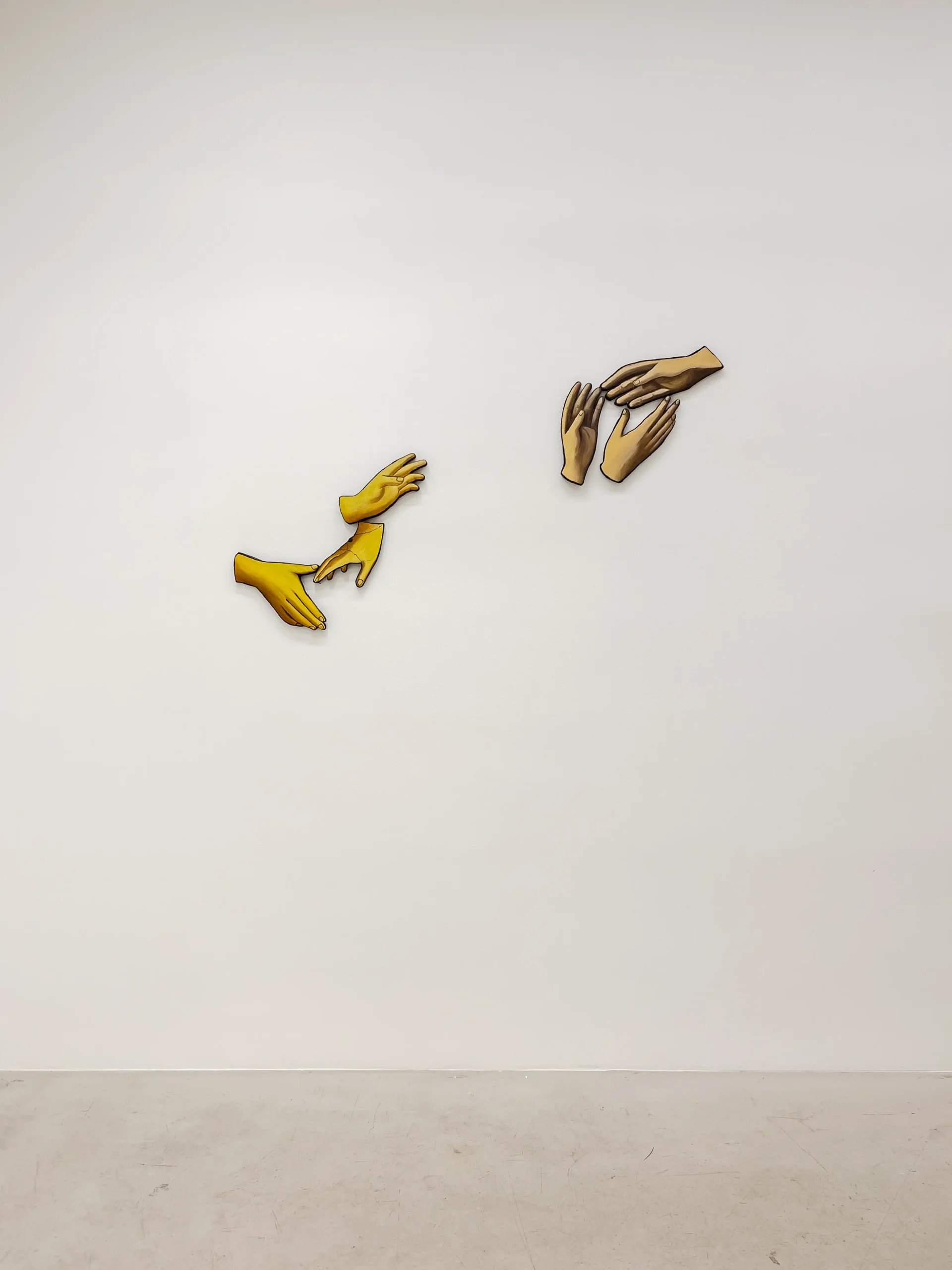
Noli me tangere and Toccati da hold opposite positions within the same interrupted encounter. In Toccati da, the hands extracted from historical paintings are repositioned until the forbidden contact occurs. Here, the bodies vanish and the prohibition remains intact.
Within Caressing Walls, the command is therefore not simply a refusal of intimacy. It defines the boundary through which intimacy must negotiate its existence. To approach another body is not to acquire it; to touch is not necessarily to hold.
The words say: do not touch me. Their light has already reached us.