How did khayamiya become part of my visual language? I encountered it first as an image, not as a tradition I intended to use. Its flat colour fields, sharply cut contours and layered construction immediately echoed my own visual instincts, then gradually changed how I could build narratives through textile. What began as a technique for constructing forms became a way of organising stories, time and space.
I discovered khayamiya while walking through Islamic Cairo. I was not looking for a textile technique, nor was I researching a traditional craft. I simply began noticing the textiles hanging in the workshops and shops around me. Men sat together cutting, folding and stitching brightly coloured pieces of fabric by hand, constructing images from layers of appliqué.
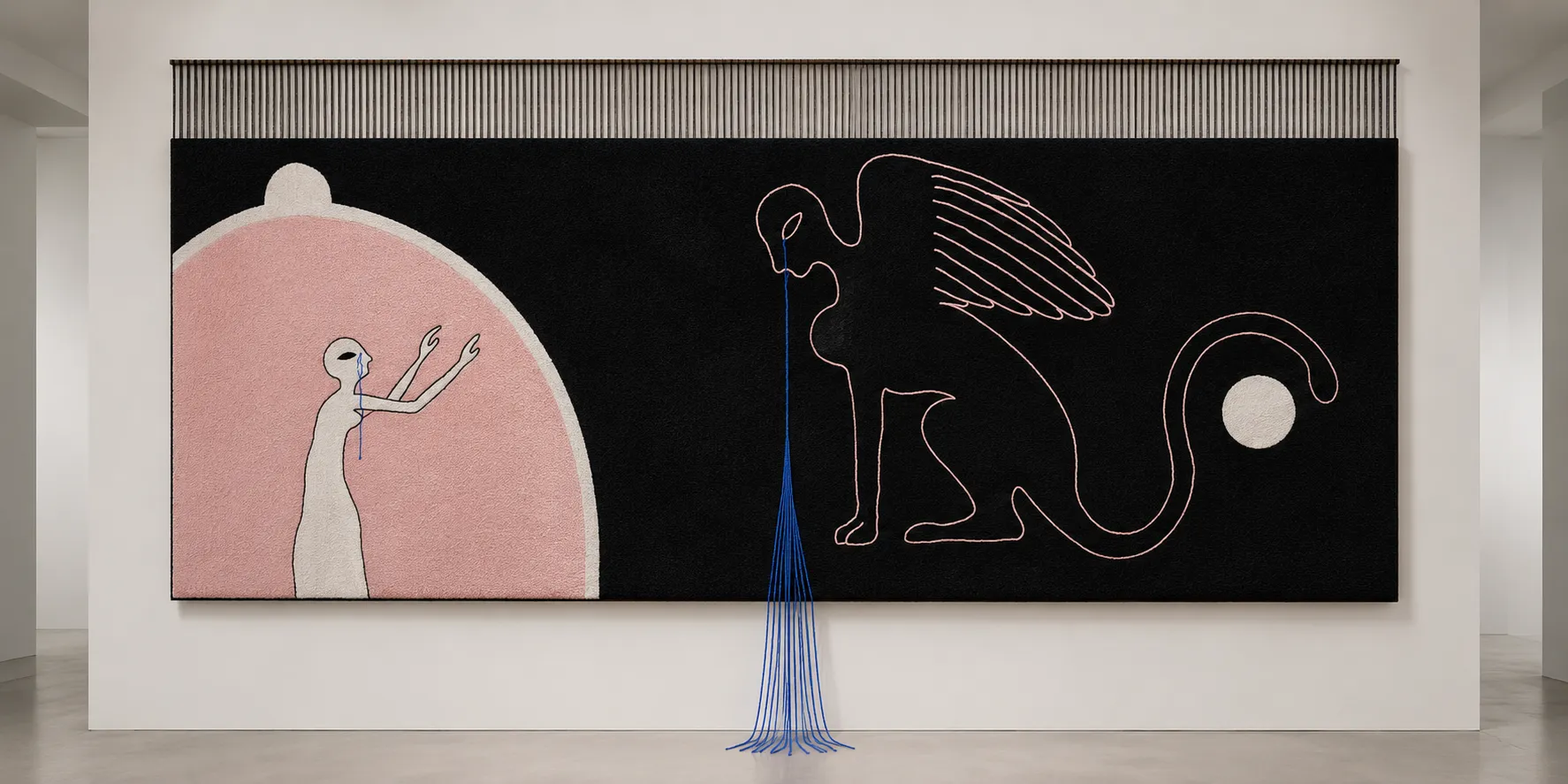
What drew me first was not the history of the technique — it was its visual language. I loved the blocks of colour, the clarity of the contours and the way every form seemed to occupy its space with complete confidence. There were no gradients, no blurred transitions and very little illusion of depth. Birds, flowers, geometric motifs and calligraphic forms were built through sharp separations between one colour and another.
There was something direct in these images, almost naïve at first sight, but their apparent simplicity concealed an extraordinary degree of control. Every curve had to be cut. Every colour had to become a physical area of fabric. Every form had to be folded, positioned and stitched into place. Nothing could remain vague or unresolved at the level of construction.
This immediately felt close to my own visual instincts. Even when my work deals with transformation, I have rarely been interested in blurred forms. I prefer strong silhouettes, clear boundaries and distinct fields of colour. The identity of a figure may remain unstable, but its outline is often precise.
Khayamiya offered a language in which clarity and ambiguity could coexist. A figure could be built from simple, flat forms and still carry contradiction, movement and uncertainty. Complexity did not have to come from shading or perspective. It could emerge from the relationship between shapes, colours and bodies.
What Years of Practice Actually Teach
My first impulse was to understand how I might make this language my own, but that proved much more difficult than I had imagined. Khayamiya may appear visually immediate, but it is a demanding technique that requires years of practice. A small error in cutting or folding can alter the rhythm of an entire curve. A line that seems simple on paper may become extremely difficult once it has to be translated into fabric.
I began learning the basic gestures because I needed to understand how the images were constructed. I wanted to know what could be cut, how one layer met another, where the fabric resisted and where the technique imposed its own logic. Learning these gestures was also a way of understanding the intelligence of the craft from within. But learning the technique did not make me a khayamiya artisan.
The knowledge belongs to people who have repeated these movements over many years, often across generations. My work with khayamiya has therefore always depended on collaboration. I bring drawings, figures, stories and compositions. The artisans bring a technical knowledge that cannot be improvised or replaced.
Finding the right collaborators was not only a question of skill — I also needed to work with people who were willing to approach the technique differently and to accept forms that did not belong to its most familiar repertoire.
The khayamiya I first encountered was largely associated with geometric structures, arabesques, calligraphy and ornamental motifs rooted in Islamic visual traditions. I wanted to introduce women, breasts, hybrid creatures, mythological figures, animals and narrative scenes that did not correspond to its conventional imagery. I was asking the artisans not simply to execute unfamiliar drawings, but to participate in the displacement of a language they knew intimately. That required trust on both sides.
Some images were strange to them — bodies or subjects they had never translated into khayamiya, compositions that challenged the technique’s traditional balance and symmetry. A gesture that felt effortless in a sketch could be impossible to cut cleanly in fabric; a curve might need to be simplified without losing the tension that made a figure work. The artisans were not simply reproducing my drawings — they showed me where a line needed to become more decisive. Working with a craft tradition does not mean transferring an image unchanged from one medium to another; the image has to be reinvented through the technique itself.
Over time, I also began pushing the physical limits of khayamiya. The works became larger. The compositions became denser. The number of figures increased. The scenes moved further away from ornamental structures and towards more complex narrative spaces. This expansion was technical, but it was also conceptual: the scale changed what the textile could contain.
A small decorative panel can hold a motif. A large textile can hold a body, a landscape, an encounter or an entire world. As the works grew, I began using khayamiya not only to construct images but to develop stories.
A few years ago, I felt the need to tell stories in a more sustained way, with a beginning, a development and an end. I did not want to illustrate existing myths. I wanted to invent my own visual myths and allow them to unfold across several works. I turned intuitively towards khayamiya.
Its flat fields of colour, clearly separated figures and layered construction allowed each scene to remain visually direct while belonging to a larger narrative. The technique gave me a way to move from one image to the next without requiring words. Gradually, the book became tapestry. Each textile could function like a page, and a sequence of textiles could form a series of chapters. But unlike a book, the story was no longer contained between covers or read in a fixed order. It could be distributed across walls, suspended in space and experienced through the movement of the viewer. The narrative became spatial.
Three Books, Three Scales
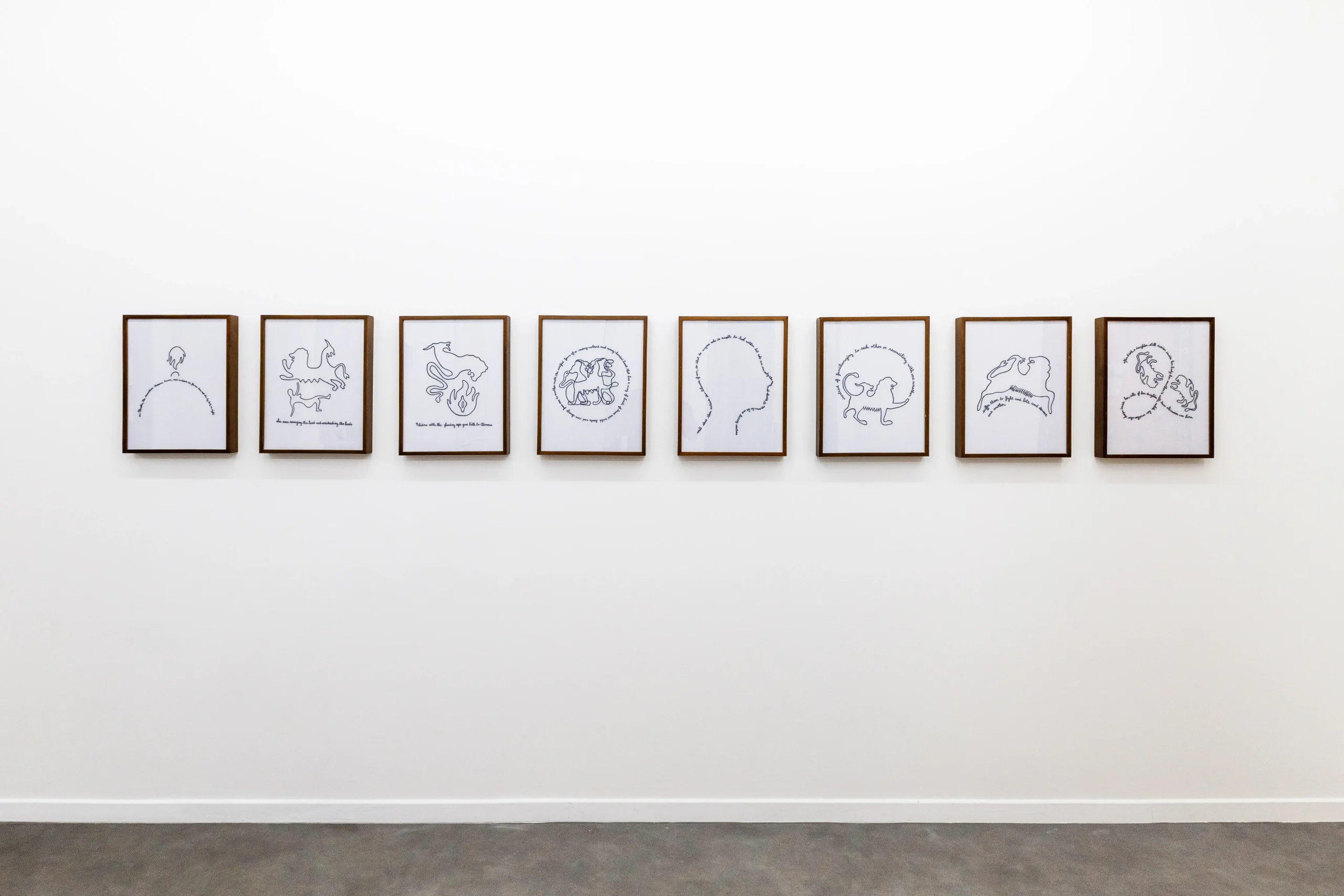
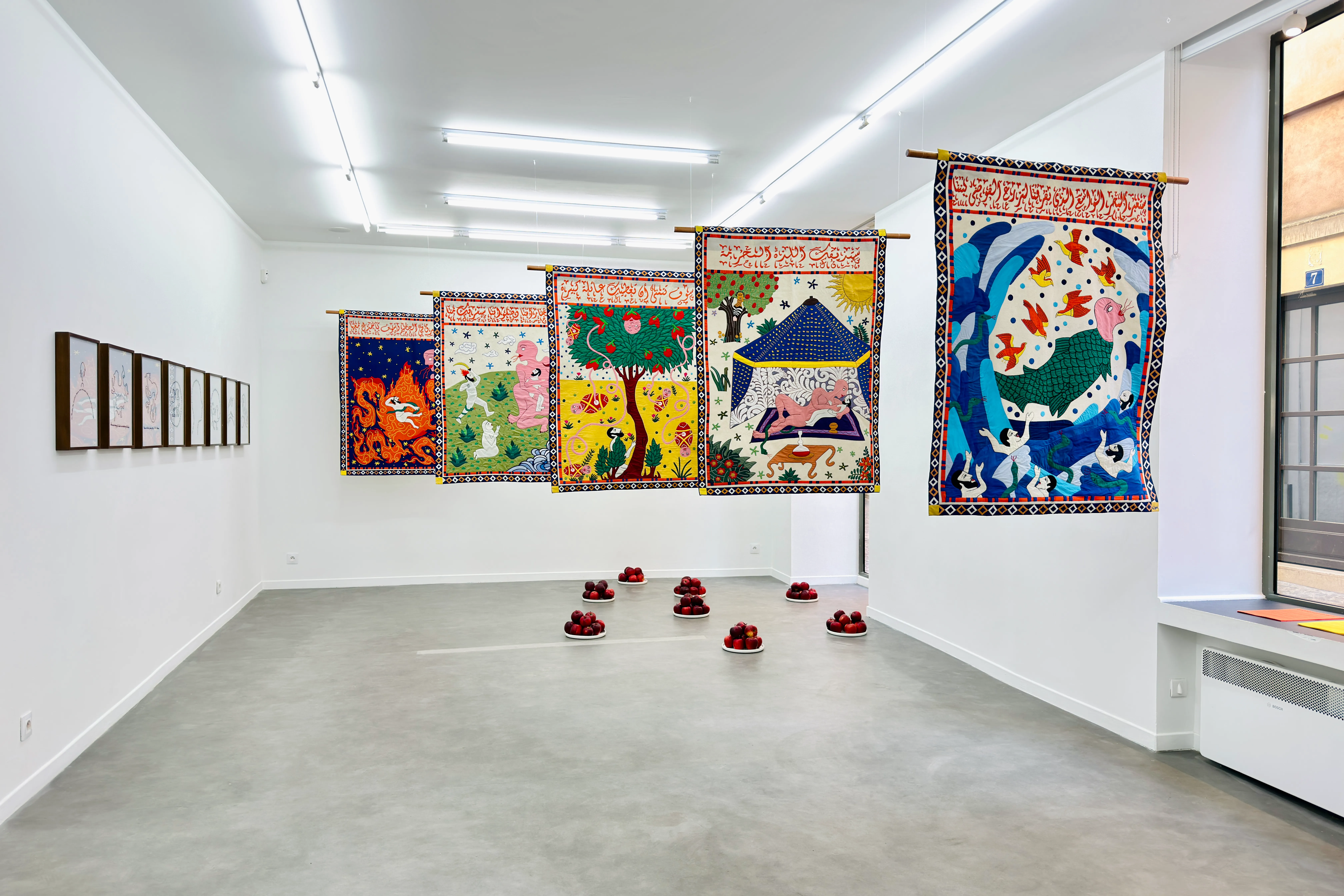
This structure first became particularly important in The Jinn from the West, which unfolds across ten chapters. Each tapestry functions as one page of the story. One scene leads to another, and the narrative develops through succession. The viewer moves from textile to textile as though turning the pages of a book, but the physical experience is different. Instead of holding the narrative in the hands, the viewer enters the space it occupies. The story becomes larger than the body reading it.
I pushed this structure further in Hayāt al-Hayāt, which unfolds across twenty chapters. The multiplication of textiles allowed the narrative to become longer, more detailed and more expansive. Each work remained a distinct page, but the sequence created a much broader cycle. The story could develop through repetition, variations in language and recurring forms. Images, words and figures travelled from one tapestry to another. Their meanings accumulated gradually rather than being contained within a single scene.
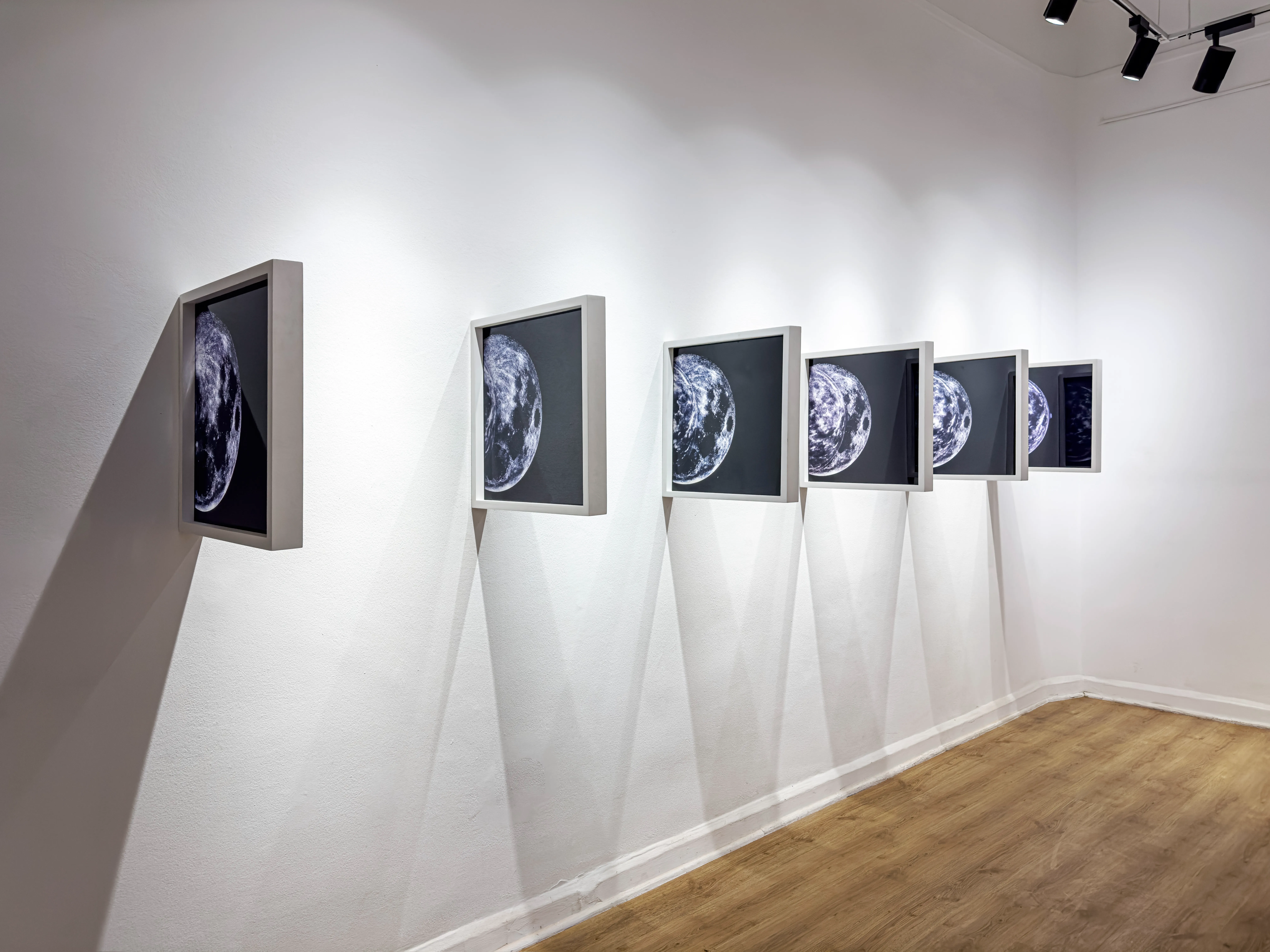
With Saisons saturniennes, the structure changed again. The work is organised in four large stages, but each tapestry measures approximately 2.5 by 2.5 metres and contains a multitude of events within the same visual field. Instead of one tapestry corresponding to one chapter or one scene, several stories now unfold simultaneously inside a single textile. Bodies meet, separate, transform or appear to ignore one another. Small narratives take place beside larger ones. Some figures seem to belong to the same event, while others inhabit a different time within the same space. The eye no longer moves only from one tapestry to the next — it travels inside the tapestry itself.
In The Jinn from the West and Hayāt al-Hayāt, the narrative is primarily sequential. The viewer progresses through a series of works, and each textile functions as one page within a larger book. In Saisons saturniennes, each page has expanded into a world. The tapestry no longer contains a single moment within the story. It gathers several temporalities, gestures and encounters into the same space. The viewer must move between them visually, deciding where to begin and how the different scenes might relate.
This changed my understanding of what storytelling through textile could become — not only a question of scale, but a change in narrative structure: the story moved from succession towards simultaneity. A linear narrative asks the viewer to follow what happens next. A spatial fable allows several things to happen at once, without abandoning the idea of beginning and ending. The viewer can follow one figure, then lose it; a secondary detail can become central. The reading remains open, even when the work belongs to a constructed narrative.
This is perhaps where khayamiya has most profoundly changed my practice: it has given me a way to tell stories without making the image obedient to the story. The textiles can carry narrative, but they do not become illustrations of a written text. The figures remain autonomous. The relationships between them can be read in several ways. The sequence may suggest an order without controlling every interpretation. The story provides structure, but the image retains its freedom.
Tradition Is Not a Sealed Past
Khayamiya also changed how I think about the relationship between tradition and invention. I am not interested in preserving the technique as though it belonged to a sealed past, nor in using it simply because its appearance is recognisably Egyptian. The tradition remains alive precisely because it can be tested, displaced and asked to carry forms it has not carried before. This does not mean ignoring its history.
On the contrary, pushing a technique requires understanding what gives it its identity. The flatness, the hand-cut appliqué, the clarity of the silhouettes, the layering of fabric and the collaborative knowledge of the artisans are not decorative effects that can be separated from one another. They are the grammar of the work. My role is not to erase that grammar, but to write something new through it.
This process continues to involve limits. There are limits imposed by the fabric, by the scale of the hand, by the time required to cut and stitch each form, and by what the technique can physically sustain. There are also limits within collaboration: differences in visual culture, in interpretation and in what each person believes the craft should or should not become. These limits do not weaken the work — they generate it.
Every project asks how far the technique can move while remaining recognisably khayamiya. How large can a work become? How many figures can coexist without the composition collapsing? How much detail can the fabric hold? Which subjects can enter the tradition, and how does the tradition transform them in return? I do not think there is one final answer; the work develops through continuing negotiation.
When I first encountered khayamiya, I was attracted to its colour blocks, its contours and its apparent simplicity. I could not yet know that it would become a structure through which I could invent myths, build narratives and transform stories into spaces. It began as a way of making images. It became a way of organising time.
Through The Jinn from the West, the tapestry became a page. Through Hayāt al-Hayāt, the pages expanded into a longer narrative cycle. Through Saisons saturniennes, each page became large enough to contain a multitude of stories within itself.
Khayamiya did not simply add another material to my practice. It changed the scale at which I could imagine, the complexity of the scenes I could construct and the way a viewer could enter a narrative. It taught me that a textile could be read, crossed and inhabited at the same time. Perhaps that is what continues to draw me to it.
A tradition built from clearly cut forms has given me a way to create stories whose meanings remain open. The edges are precise, but the narrative continues beyond them.
Related Series
Related Studio Notes