Why did I begin making sculptures from bread? Bread entered my work before I understood what it might symbolise. After my father’s death, I placed my hands in dough and began shaping a face; the material then swelled, cracked and altered everything I thought I was making. It became a way to record grief physically while teaching me that matter can participate in producing the thought of an artwork.
People often ask me why I work with bread, and the question almost immediately turns towards symbolism. Bread carries centuries of religious, political and cultural associations. It can evoke nourishment, communion, sacrifice, labour, survival or sharing. It belongs to ritual as much as it belongs to ordinary life. But none of those meanings explains how it entered my work.
The Article I Almost Ignored
After my father died in 2023, I began searching almost compulsively for something that might help me move through grief. One evening, I came across a short article suggesting that baking bread could be soothing. I no longer remember where I found it or who wrote it. I only remember thinking that the advice seemed almost absurd in relation to what I was experiencing, as though flour, water and an ordinary domestic gesture could have any relationship to the death of a parent.
Still, the following day, I bought flour. I never made a loaf: as soon as my hands entered the dough, they began shaping a face.
I was not trying to make a portrait of my father, nor was I trying to reproduce my own features faithfully. I was trying to give form to the moment when grief becomes entirely physical. Tears disappear quickly. Once they dry, almost nothing remains to prove that they were ever there. Yet crying changes the whole body: vision blurs, breathing contracts, the face swells, the throat closes and language seems to recede. I wanted to know whether that moment could leave another kind of trace.
Each time I cried, I began making another mask. I still do. The gesture became a simple rule. Grief returns, I prepare the dough, and a new face enters the series. The masks do not represent grief in general. Each one belongs to one particular encounter with it: a specific day, a specific memory, a specific intensity of crying. The ritual repeats, but the experience never does.
What Does Dough Actually Record?
This is part of what made bread so important. Dough receives the body directly. It records pressure, hesitation, force and repetition. It stretches, collapses, resists and tears. A gesture made quickly leaves a different trace from one made slowly. The material does not simply submit to the hand. It responds to it.
I may begin with the intention of making a face, but the dough always changes that intention. The eyes swell. The features move. The surface cracks. Forms that initially seem anatomical become increasingly uncertain. Sometimes the swollen eyes begin resembling breasts. At other times, they look like wounds, tumours or unfamiliar organs. The face drifts towards the body without entirely becoming it. This was not something I decided conceptually before making the work. It emerged from the behaviour of the material. Bread made it impossible for the image to remain completely under my control.
Before baking, the dough is soft, responsive and almost alive. In the oven, it rises, contracts and hardens, and afterwards it continues to dry — so the form I shape with my hands is never exactly the form that remains. The mask becomes a record not only of what I did to the dough, but also of what the dough did in return. Before working with bread, I usually approached a material through an idea already formed; bread reversed that movement. I did not fully understand the work before touching the material — it participated in producing the question.
What can a face become when the substance carrying it continues to move? How can grief be recorded without being illustrated? These questions did not precede the masks. They came from making them.
The first masks were not conceived as symbols. I was not trying to use bread as a code for the sacred, the domestic or the body. I was working with it because it could receive an experience physically. It retained pressure, distorted the face, carried time and remembered the hand.
Only later did the wider cultural histories of bread begin to enter my understanding of the work. Its relationship to nourishment, ritual, scarcity, labour and communion could not be ignored, but those associations arrived after the encounter with the material. We often assume that bread signifies nourishment, marble permanence and textile domestic labour. My experience was the opposite: the material did not illustrate a thought I had already completed. It changed what I was able to think.
The masks also became a way of confronting the disappearance of tears. Crying is one of the most visible expressions of grief, but it leaves almost no durable evidence: the body changes temporarily, then returns to its ordinary appearance. The dough offered another duration. It could receive the swollen features of crying and carry them forward — not preserving the face exactly, but preserving a transformation of it. The mask became less a portrait than an archive of a particular physical state, one that remains unstable in meaning even when the object itself remains.
A viewer may see a face, a breast, a wound, an organ or something closer to a ritual object. The forms do not settle completely into one category. Bread makes the body recognisable and unfamiliar at the same time. This ambiguity became central to the series.
The masks begin from my face, but they are not self-portraits. They begin from my grief, but they are not illustrations of my biography. They originate in a private experience, yet their forms connect to much older histories of mourning, ritual and bodily expression.
Only after the work had begun did I start researching mourning practices more deeply. I encountered images and descriptions of female mourners in Greek and Egyptian antiquity, who struck their chests, pulled their hair and transformed private sorrow into a visible, collective act — the body as the place where mourning could circulate from one person to another. I had not begun the masks to illustrate those traditions; I discovered them because the masks had already led me there. The gesture came first, the historical connection arrived later. Through repetition, gesture and the body, a private act began to touch a collective memory.
Bread allowed this partly because it already belongs to both the intimate and the shared — touched, kneaded, passed from hand to hand and consumed, one of the most ordinary materials imaginable, yet carrying a cultural and emotional density that far exceeds its physical simplicity.
But the bread in Bake Your Pain is no longer made to be eaten, and that shift matters. The dough passes from food into sculpture, kneaded, shaped and baked, but its final purpose is not consumption. Although bread is usually associated with rapid decay, I developed a process of thoroughly drying and sealing the masks against humidity, allowing them to be exhibited and conserved over time — a material assumed fragile and temporary becomes capable of preserving the trace of an experience. It can be installed, transported and accumulated as part of a growing body of work. This permanence creates a strange contradiction: the mask remains, but the moment that produced it does not. The bread becomes stable, while grief continues to change. The artwork preserves a trace without preserving the experience itself.
I think this is one reason the series continues. Each mask records another encounter with grief, but none can become the final mask. No object resolves the loss or contains it completely. The series remains open because grief does not repeat itself in an identical form. A new mask does not replace the previous one — it joins it.
Over time, the individual faces begin forming a larger sculptural archive. One mask may remain closely connected to a particular moment. Many masks together begin to suggest something more collective: a chorus, a gathering of mourners or a community built from repeated encounters with absence.
From the Hand to the Room
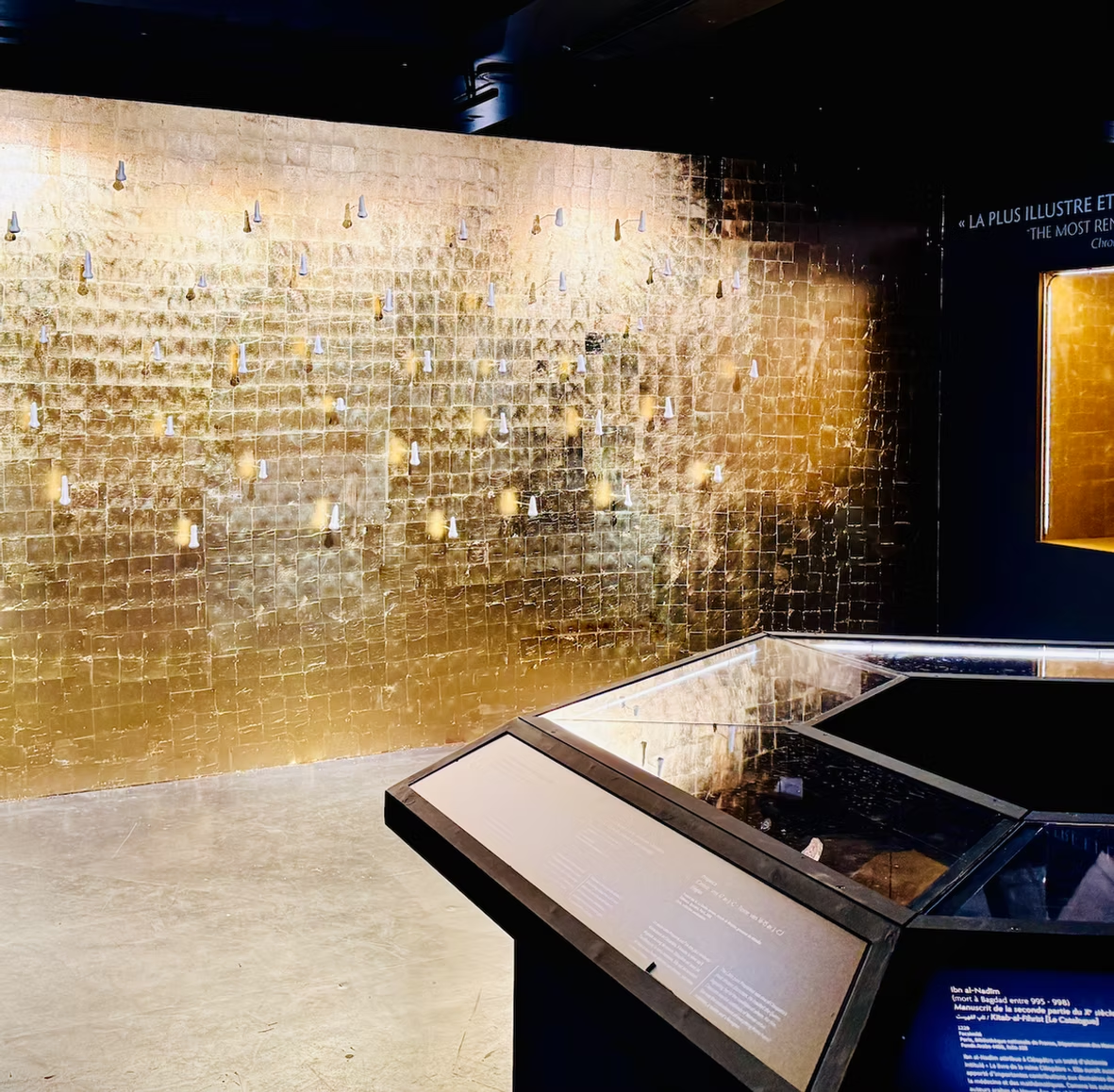
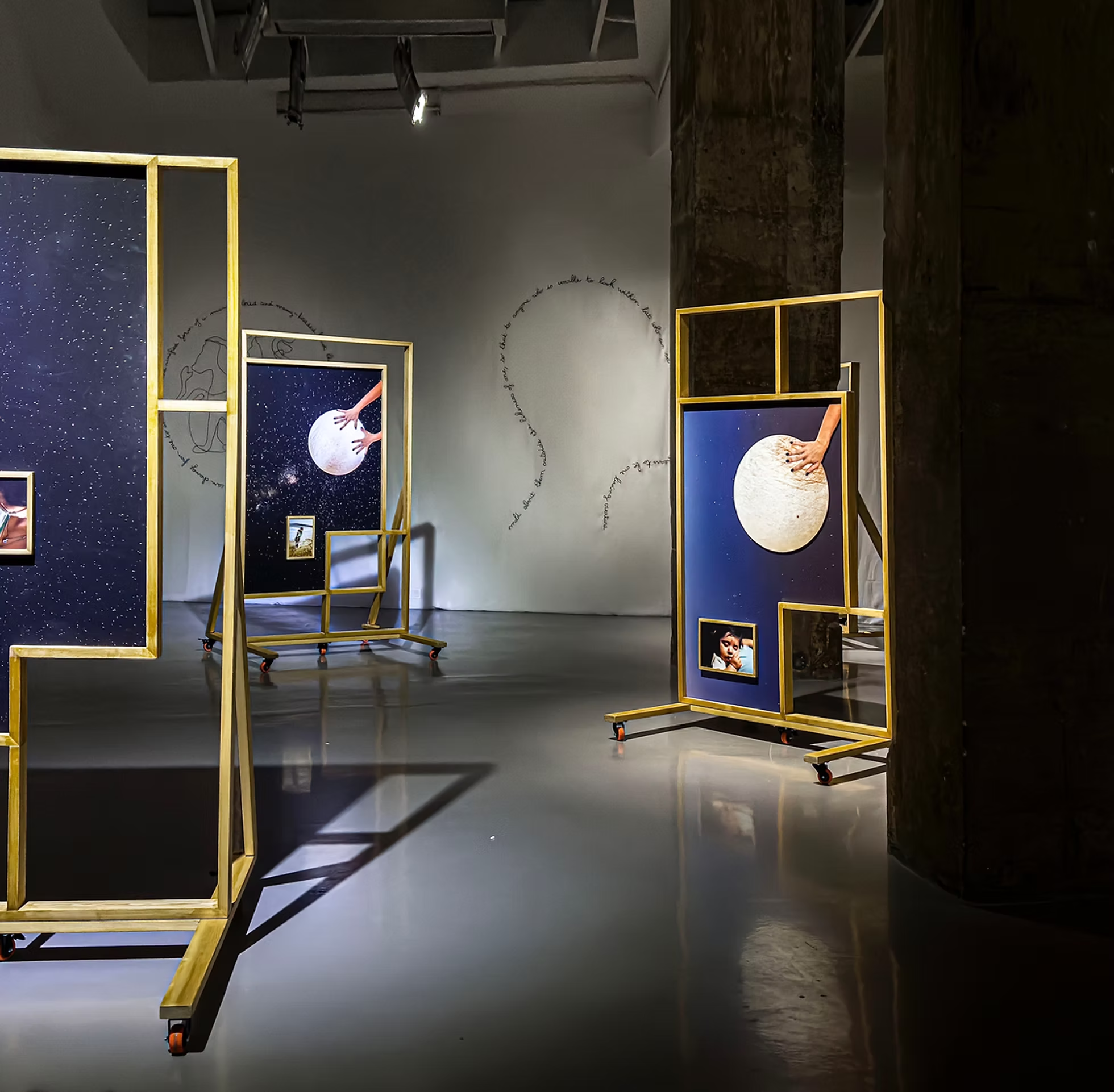
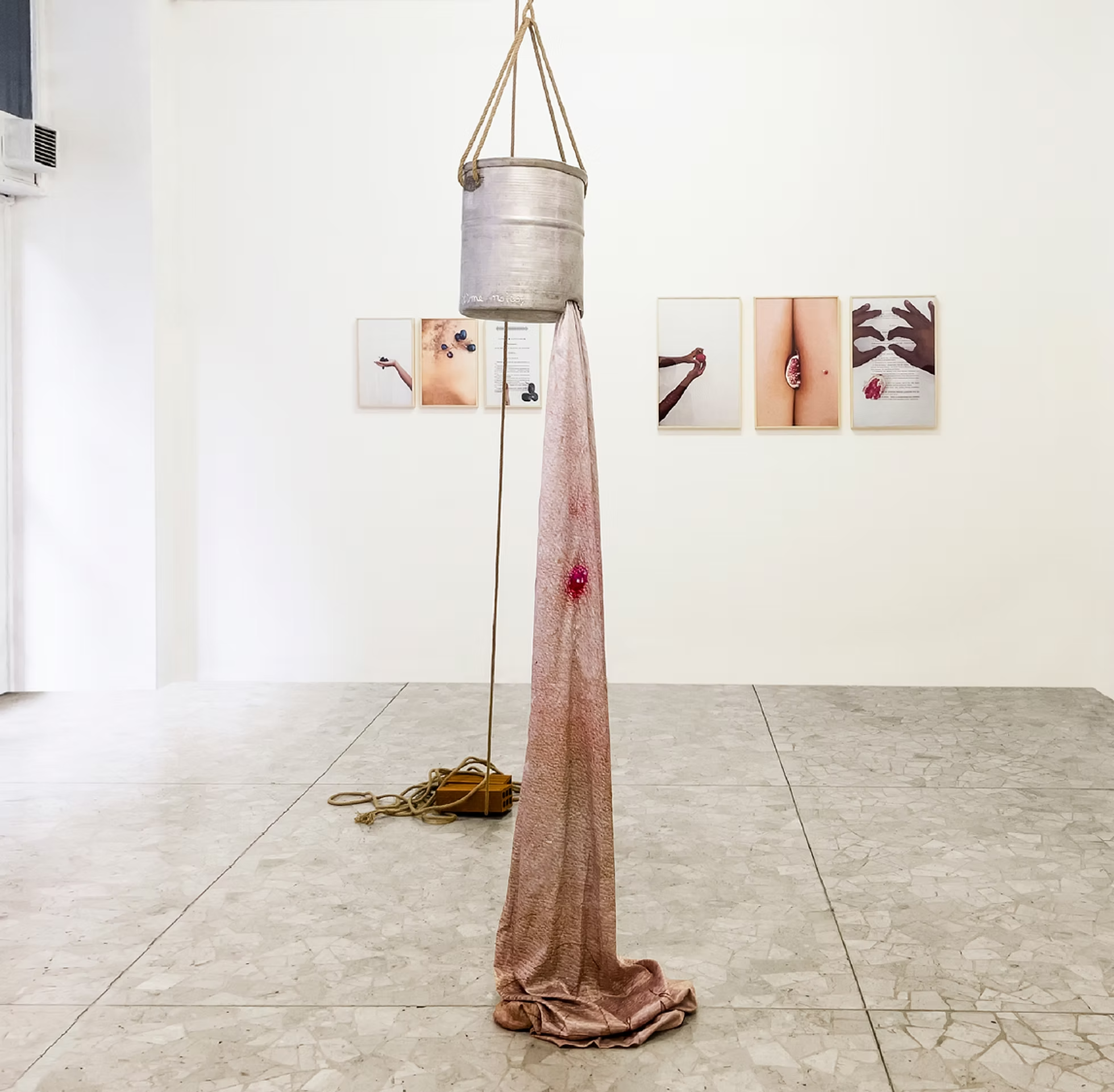
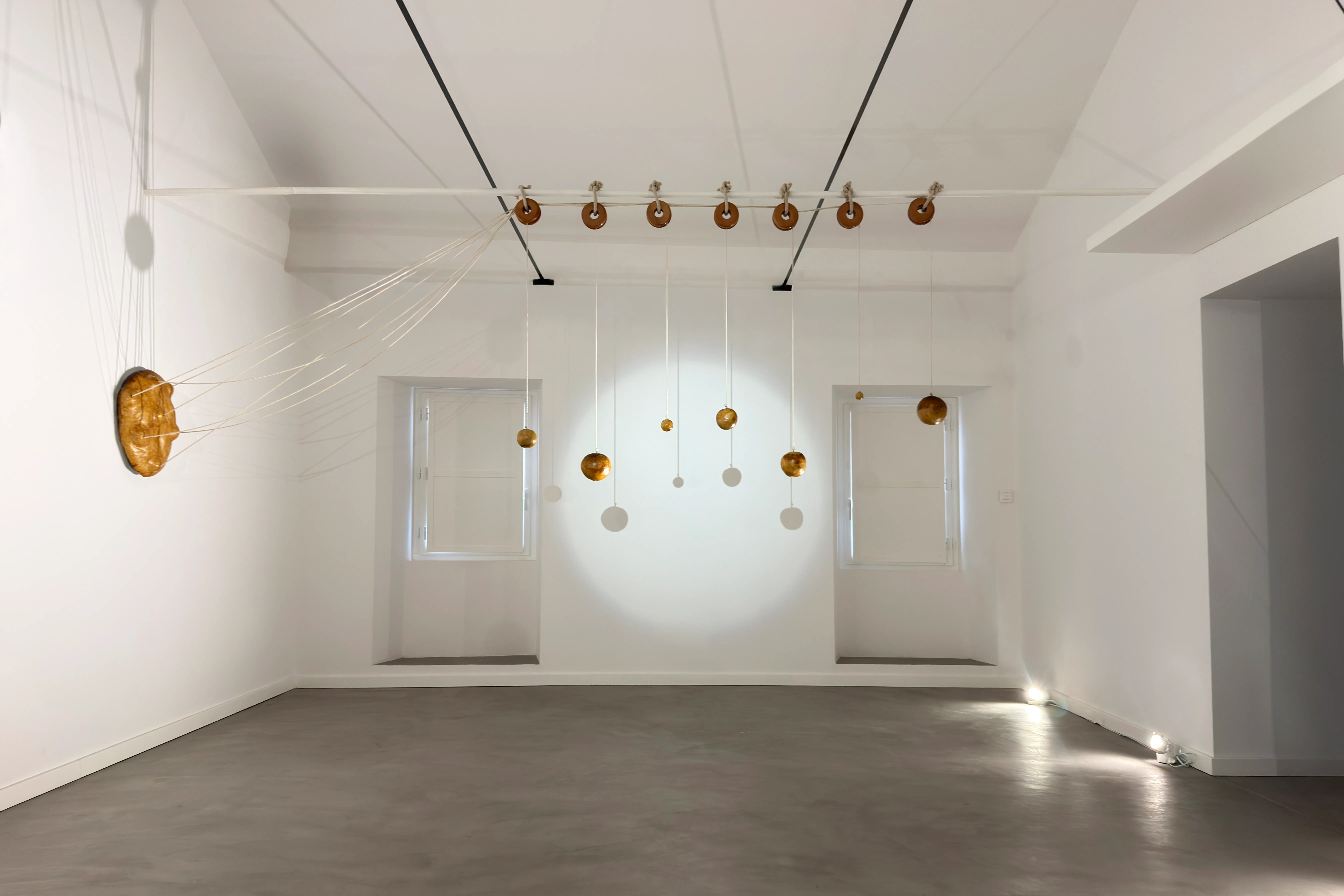
The installation changes the scale of the gesture. What began between my hands and a piece of dough becomes architectural. The masks occupy walls, hang from ropes or enter systems of pulleys, weights and suspended elements. The intimate gesture is expanded into a spatial experience. Bread is no longer only a substance carrying the impression of my fingers — it becomes part of a structure.
This movement from the hand to the room has also changed how I think about sculpture. A sculpture does not need to begin with a monumental or traditionally durable material. It can begin with something domestic, edible and apparently insignificant. Its power may come precisely from the distance between what the material usually does and what the artwork asks it to become.
Bread is normally consumed — here, it watches. Bread normally disappears — here, it accumulates. Bread normally nourishes the body — here, it records what the body has endured. The material carries these contradictions without needing to explain them.
This is why I remain cautious when the work is reduced to the symbolic meaning of bread. Symbolism can become a shortcut. It may allow the viewer to recognise nourishment, religion or sacrifice immediately, but it can also distract from what is happening materially.
The dough is not only representing transformation — it is transforming. It is not only representing time — it is carrying time through its changing state. It is not only representing the body — it has received the pressure of a body directly. The material performs part of the thought.
This discovery travelled into the rest of my practice. In textile, I became more attentive to the way a technique changes an image rather than simply reproducing it. In stone, I began thinking more carefully about resistance, weight and what a material allows or refuses. In installation, gravity, tension and suspension became active parts of meaning rather than technical problems to solve afterwards. The materials changed, but the question remained. What can matter do that language cannot?
Bread taught me that a material could hold an experience without explaining it. It could carry the trace of a body while refusing to become a literal representation of that body. It could preserve a moment without pretending to restore what had been lost.
The masks do not repair grief. They do not replace the person who died, and they do not transform absence into presence in any complete way. But they allow one encounter with that absence to take form and remain.
Permanence does not mean freezing an experience in place. The object may remain stable, but its meaning continues to move. Each mask enters new installations, new relationships and new readings. The sculptural form endures while the emotional and conceptual life of the work remains open.
Looking back, I realise that Bake Your Pain was not simply the beginning of a new series. It marked a deeper change in my practice. Until then, I often began by asking what I wanted a work to say. Bread taught me to ask something else: what can a material do, what can it remember, and how might its behaviour change the thought that produced it?
Bread did not only become a material in my work — it changed the way I understood what materials are capable of doing.
Related Series
Related Studio Notes