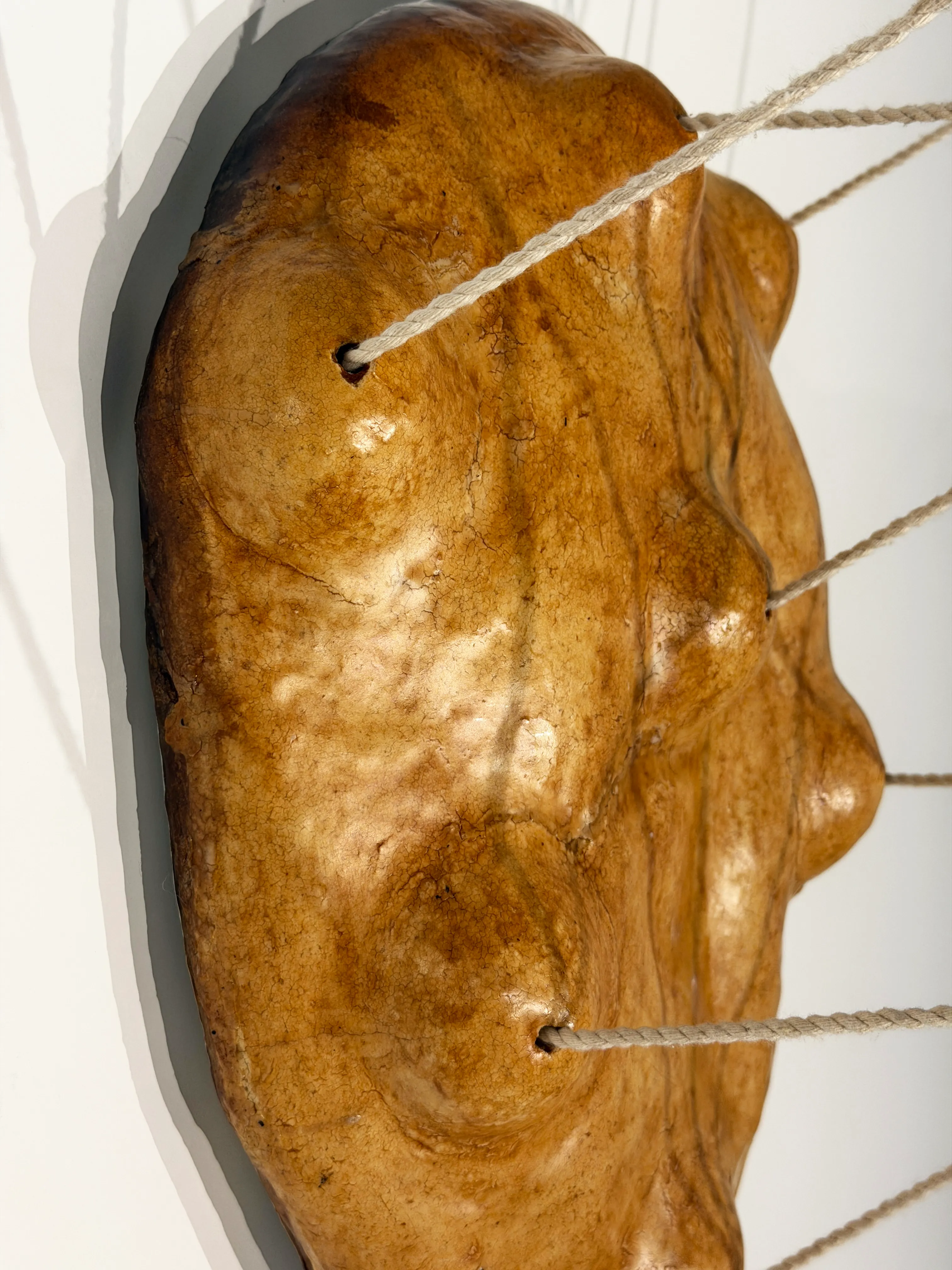
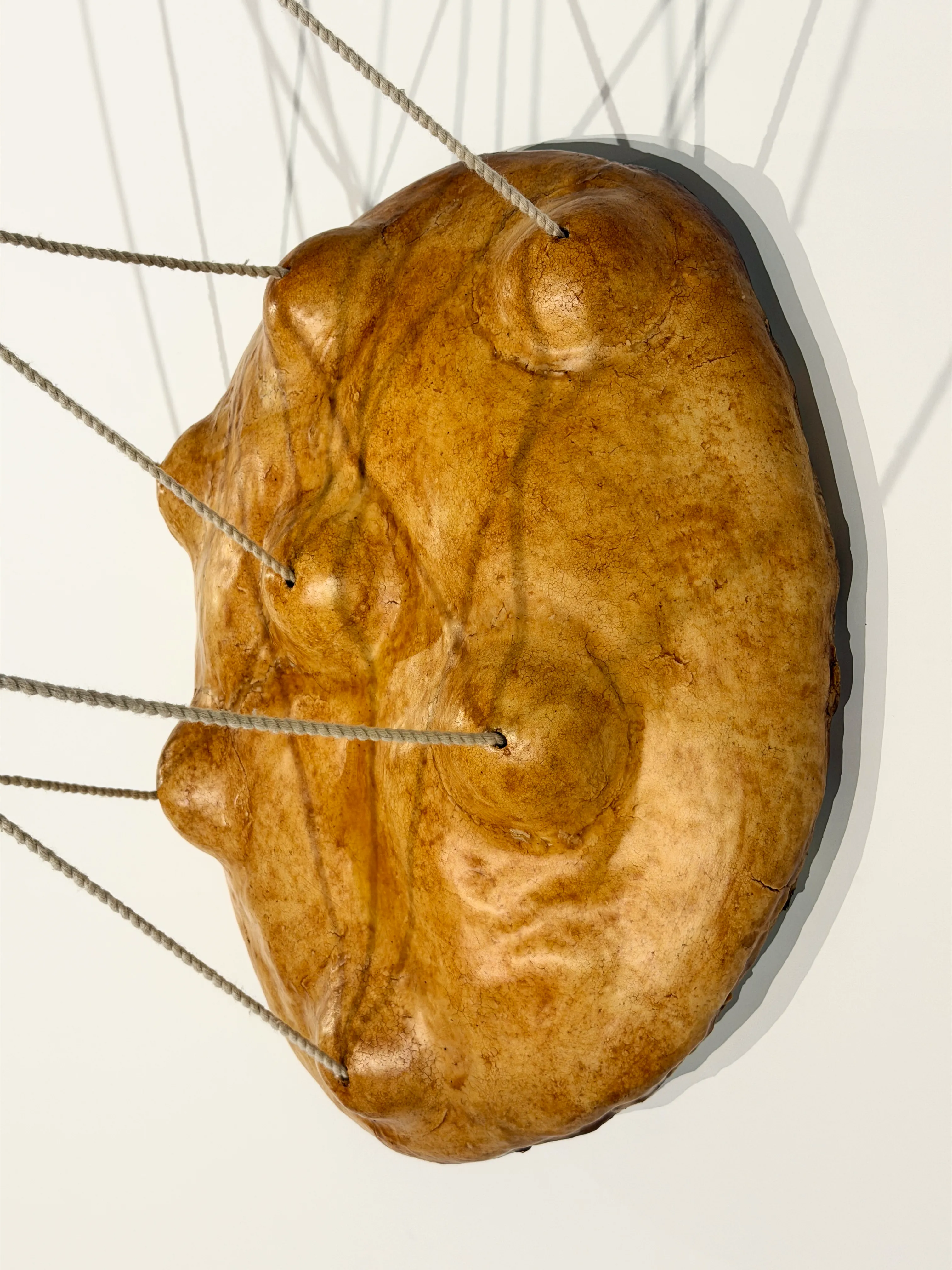
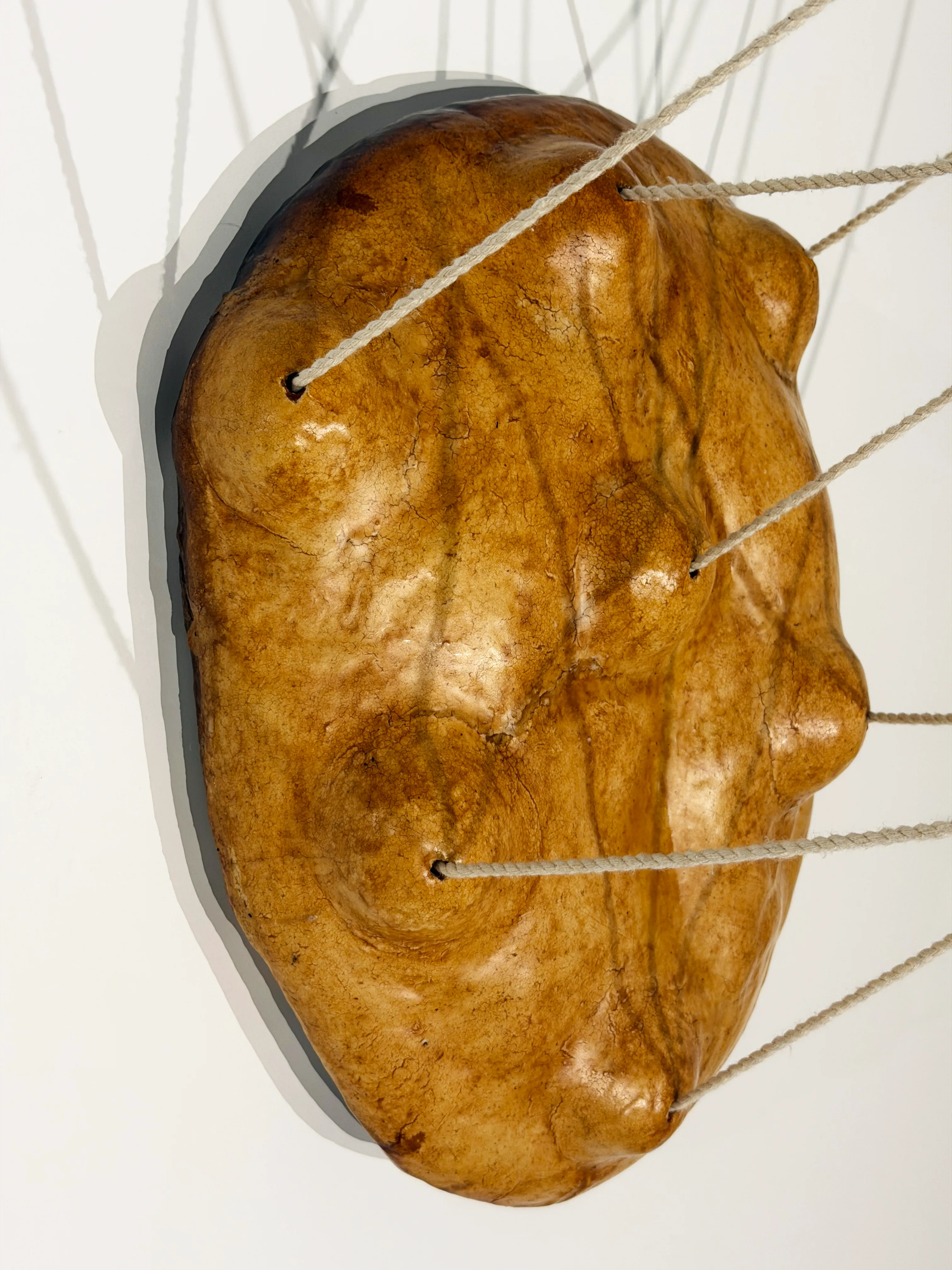
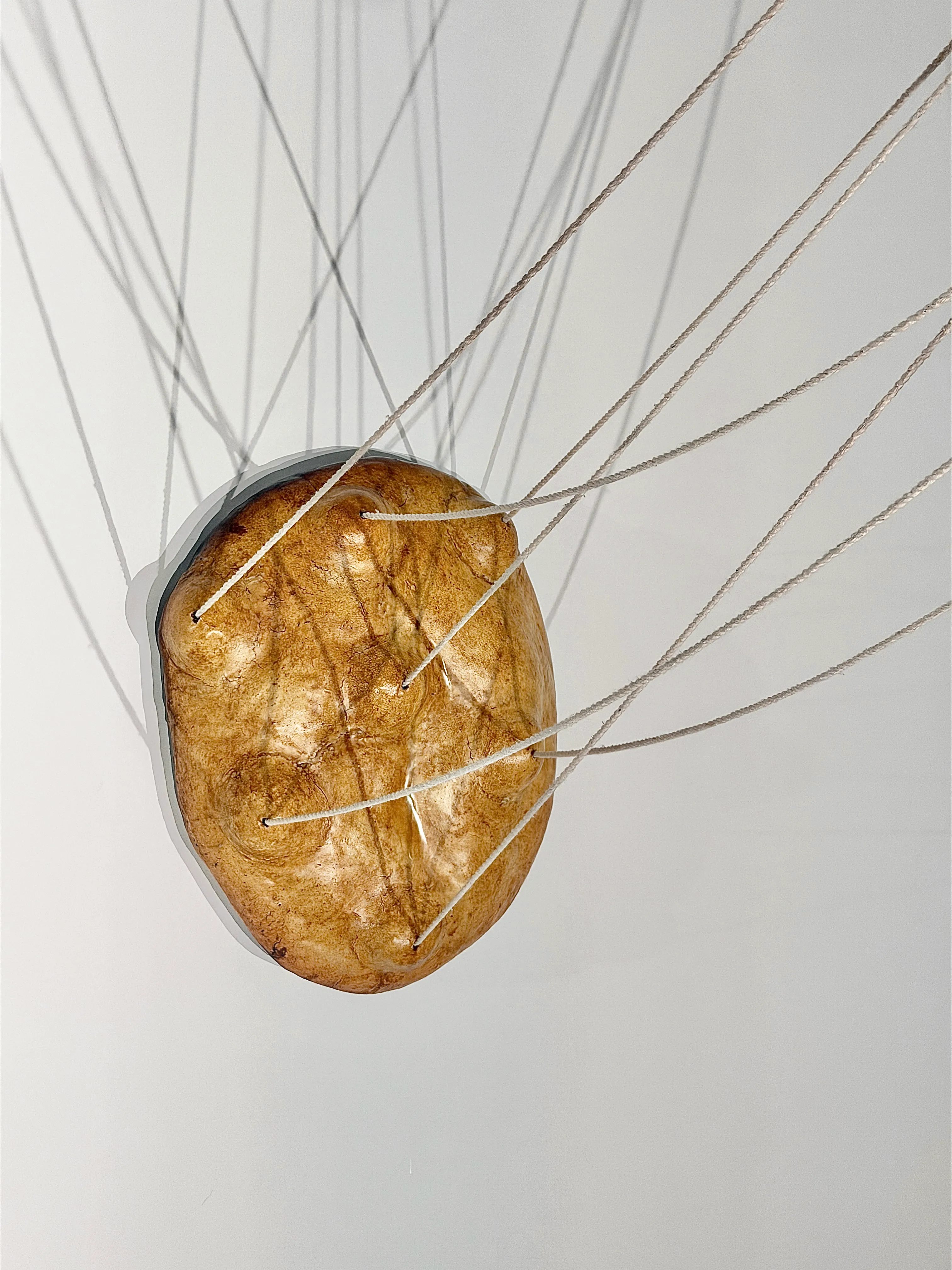
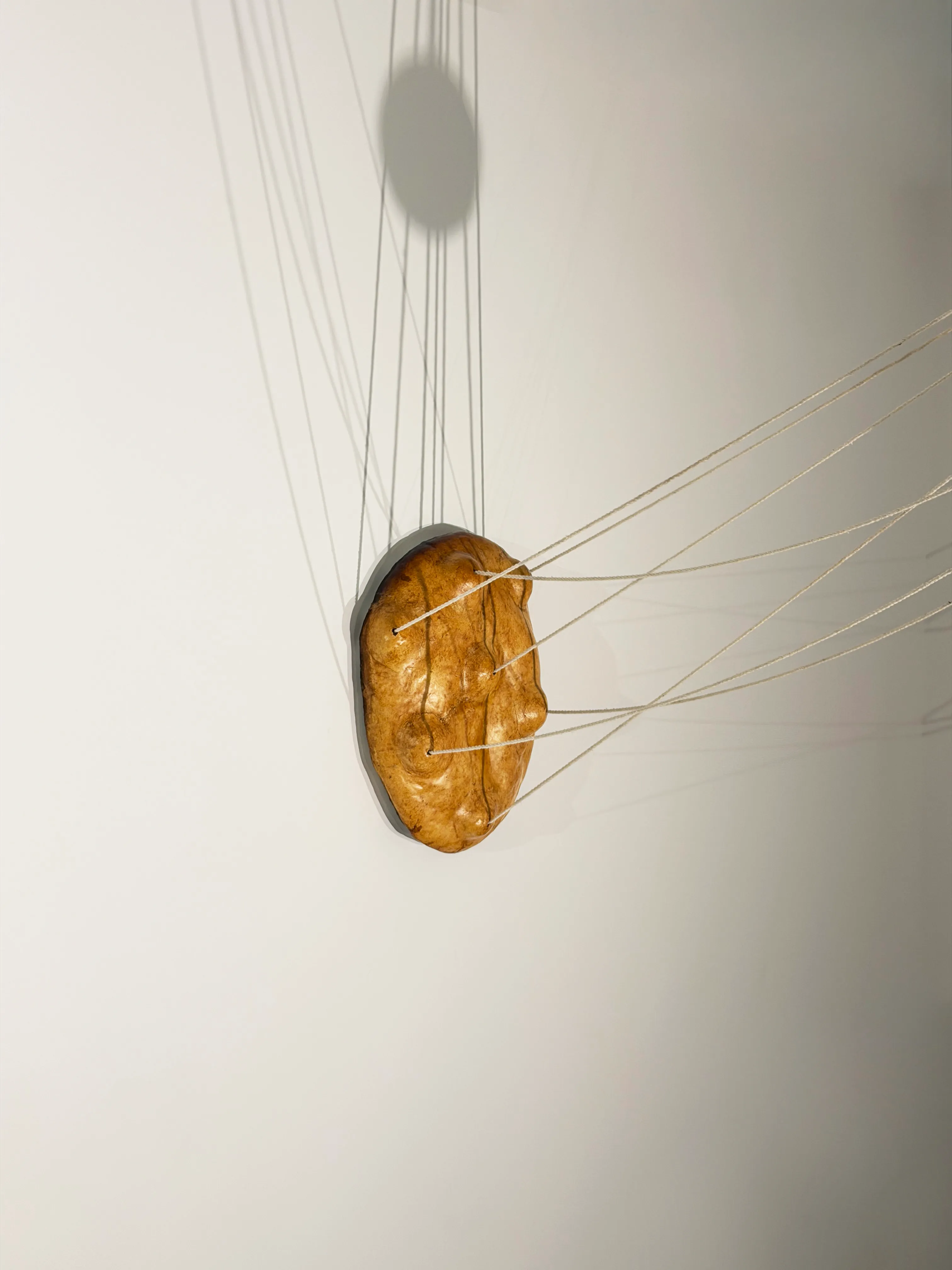
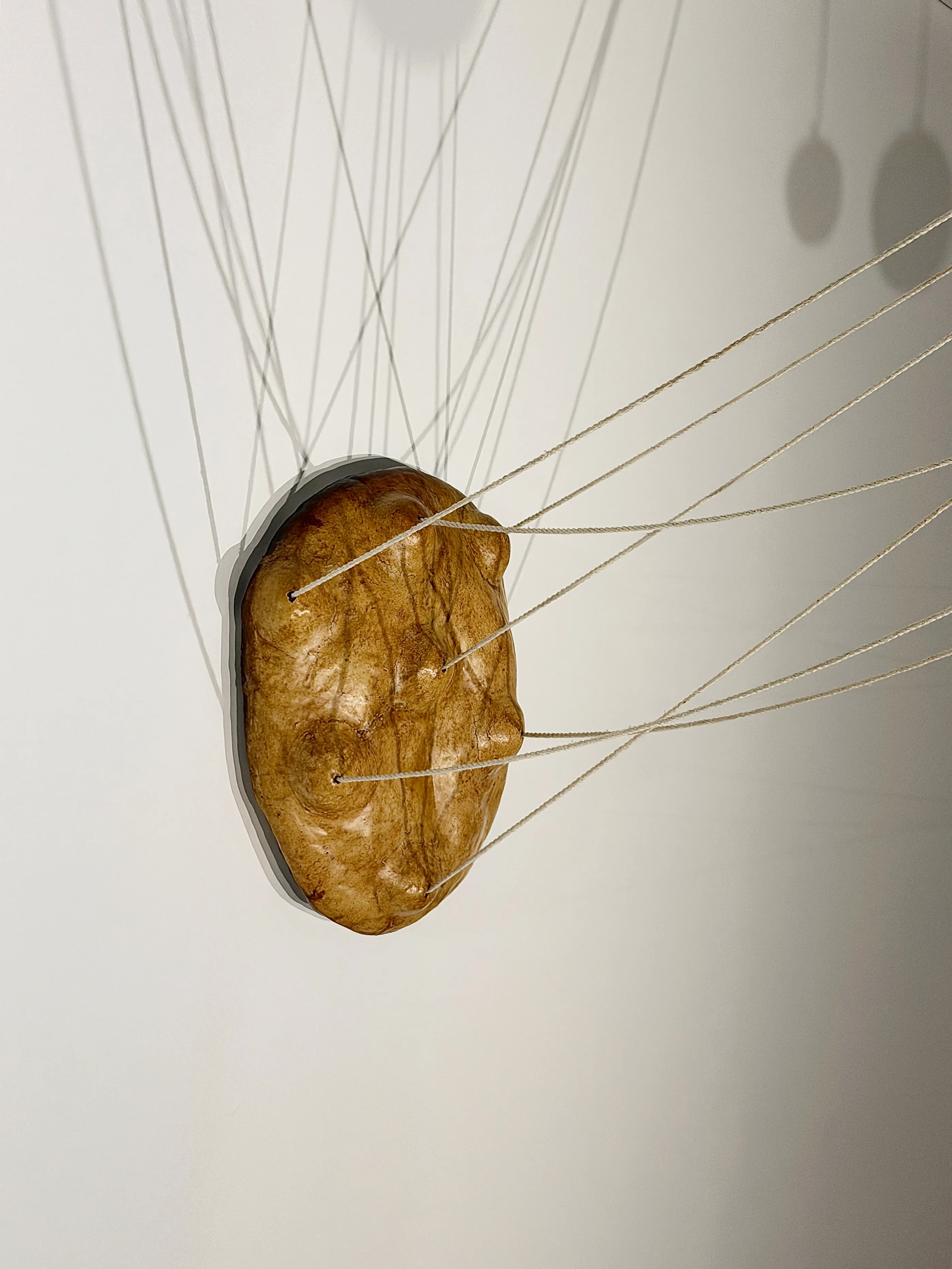
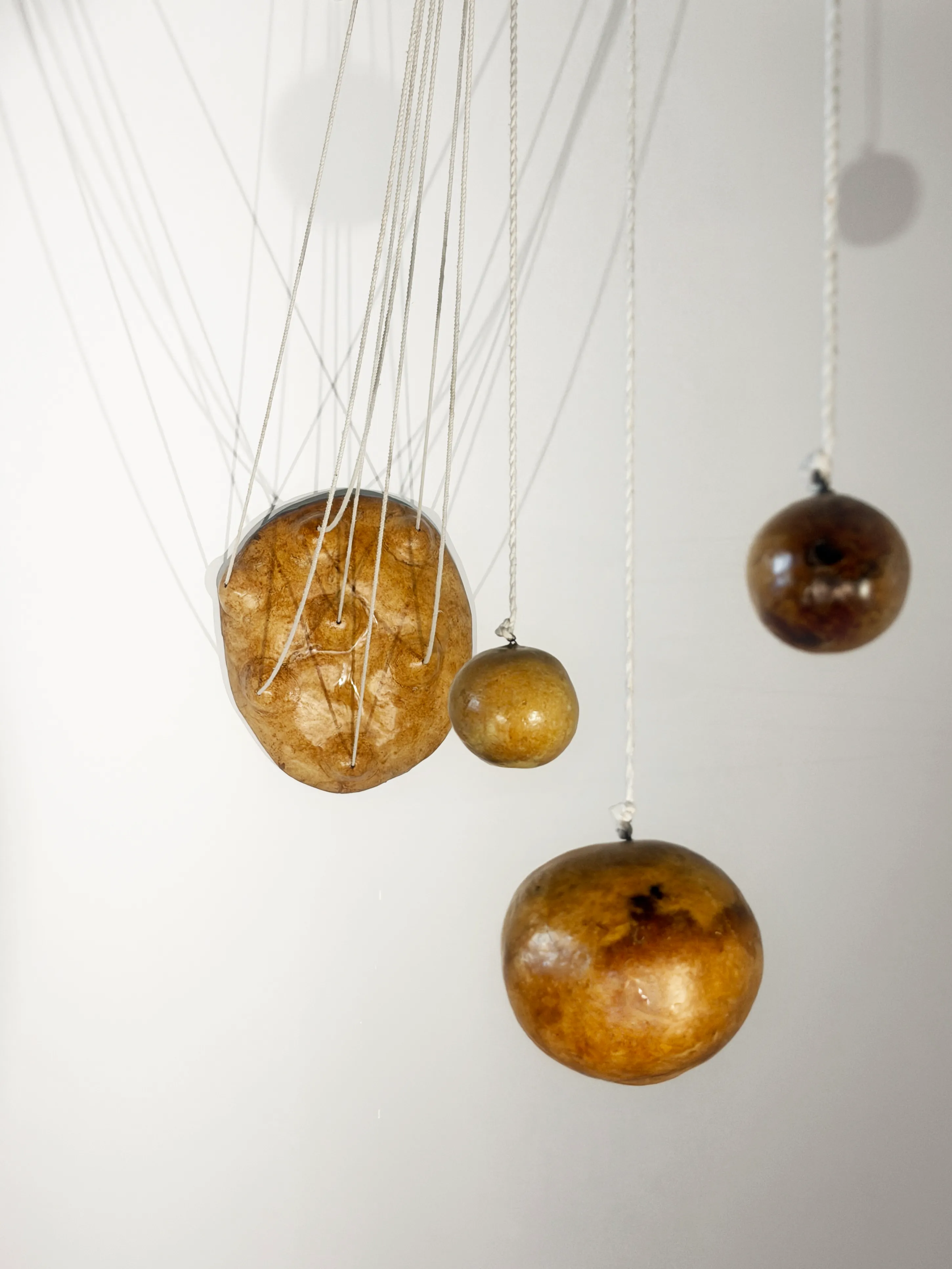
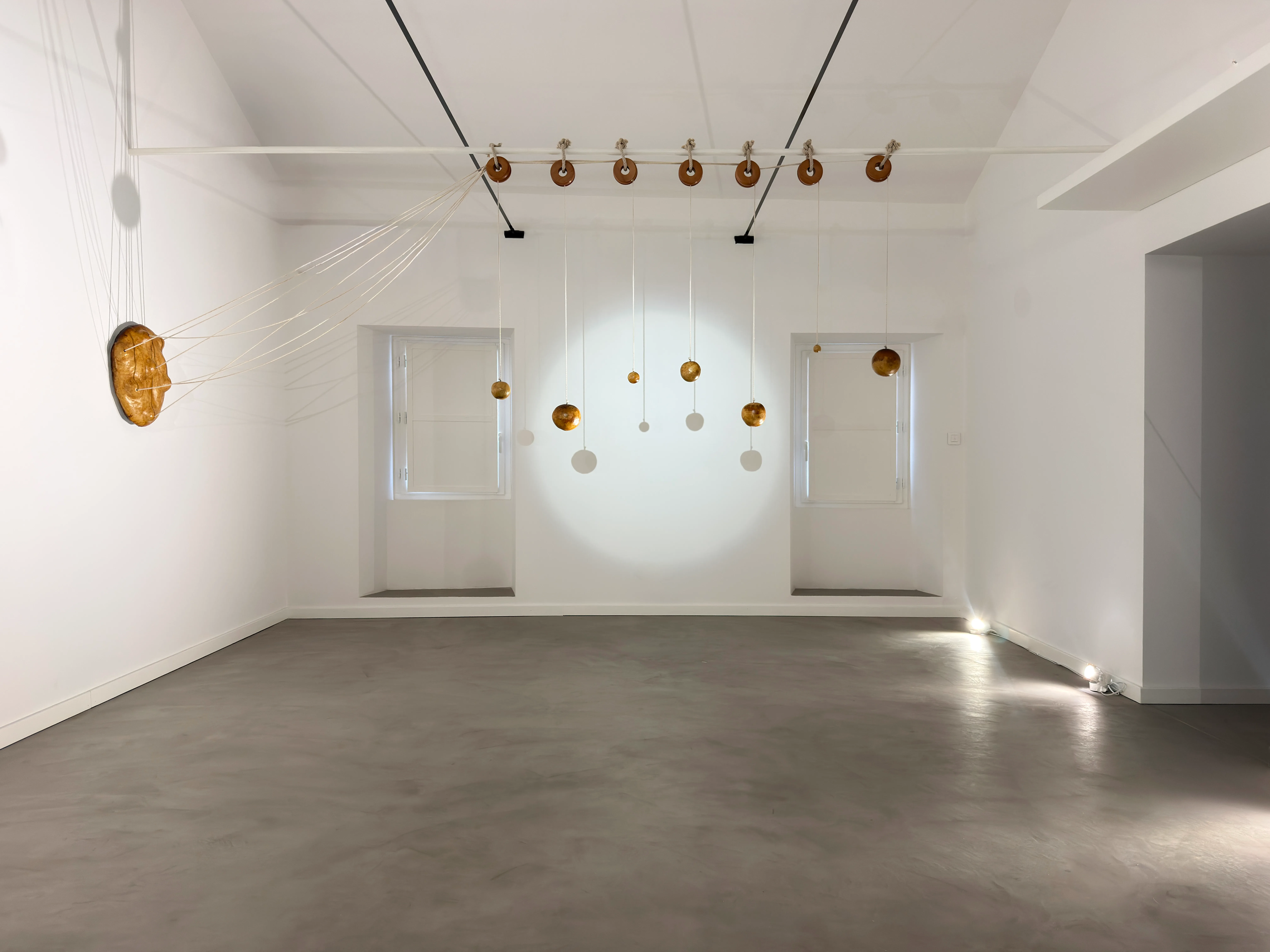
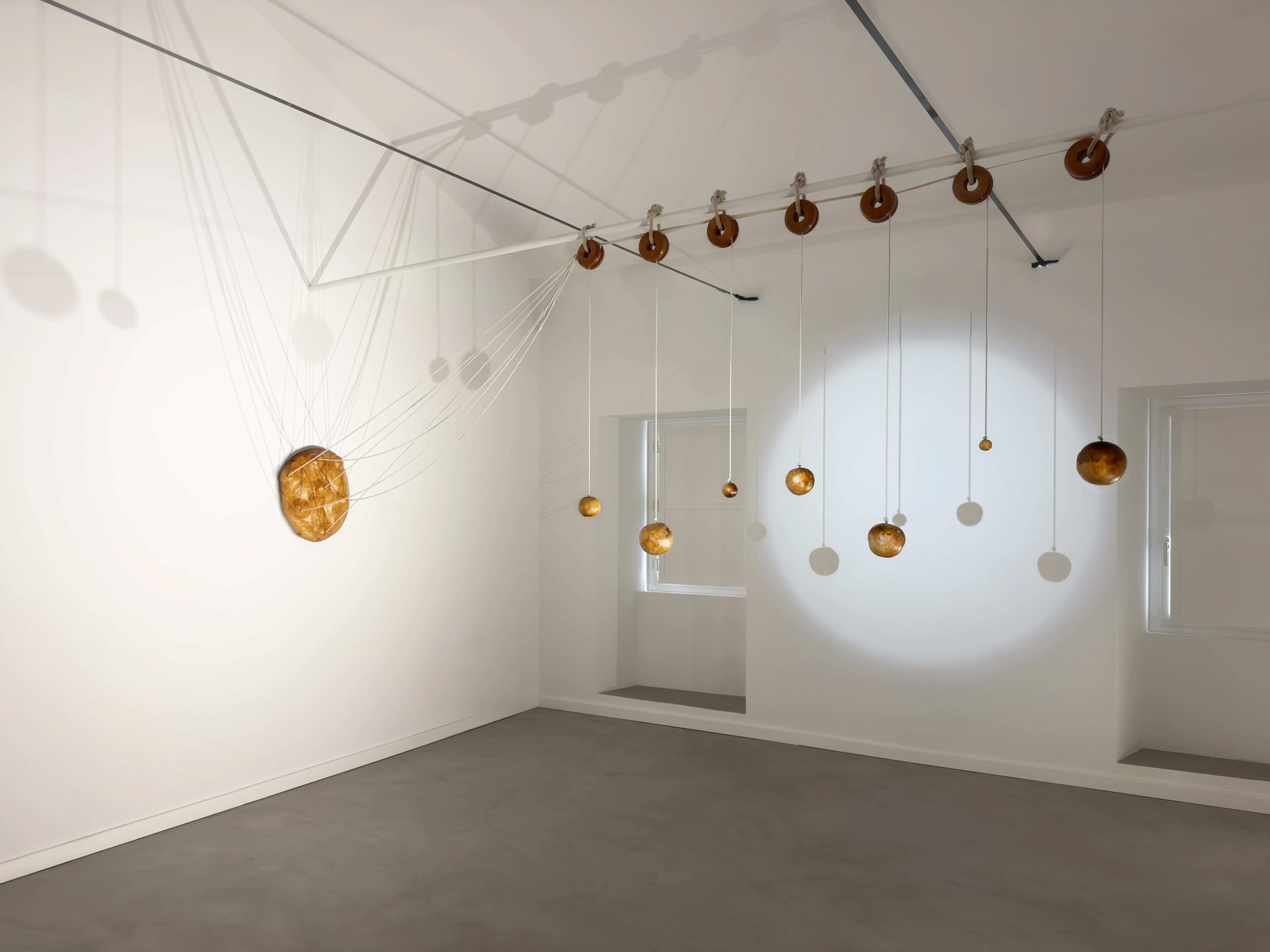
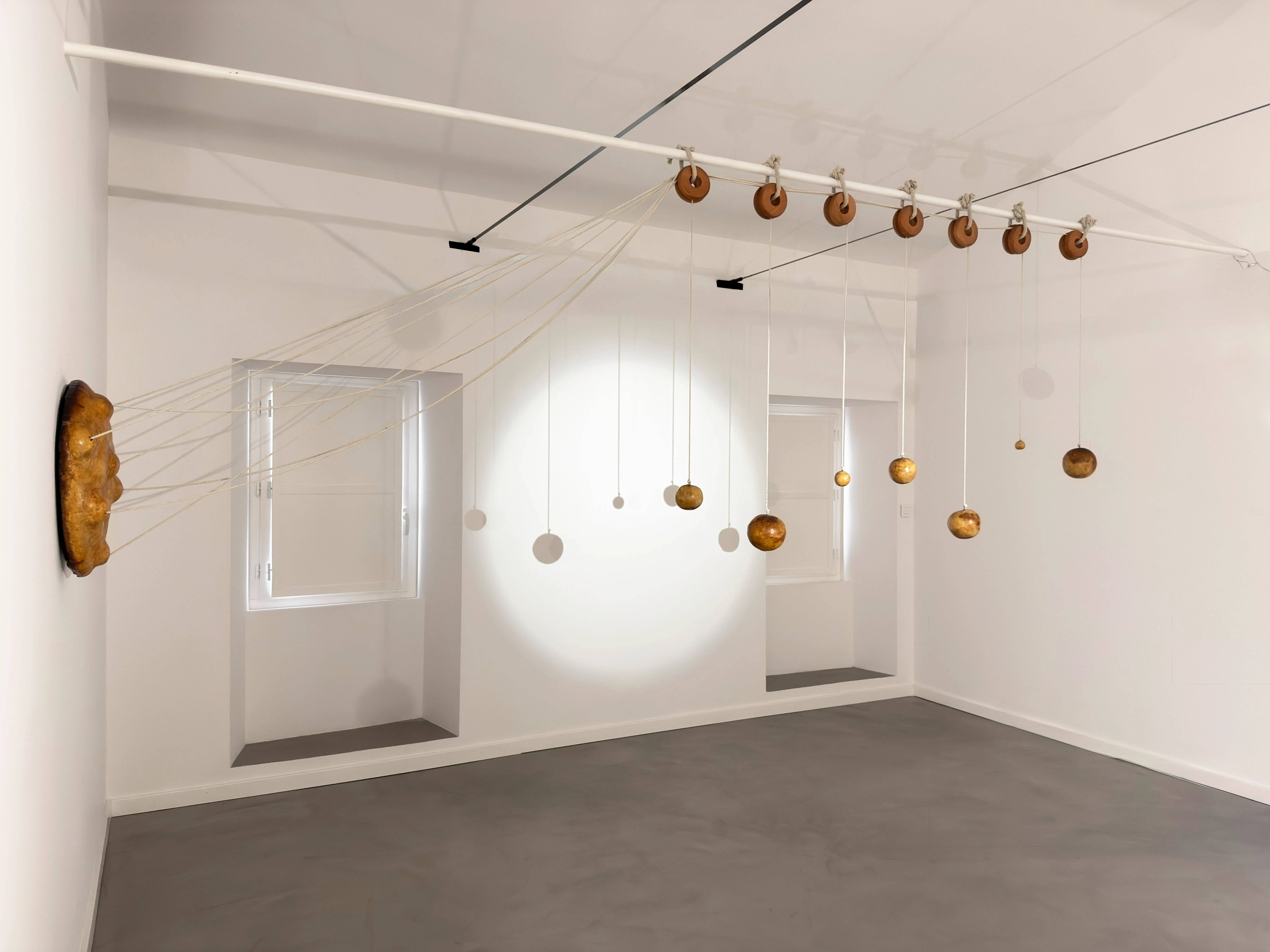
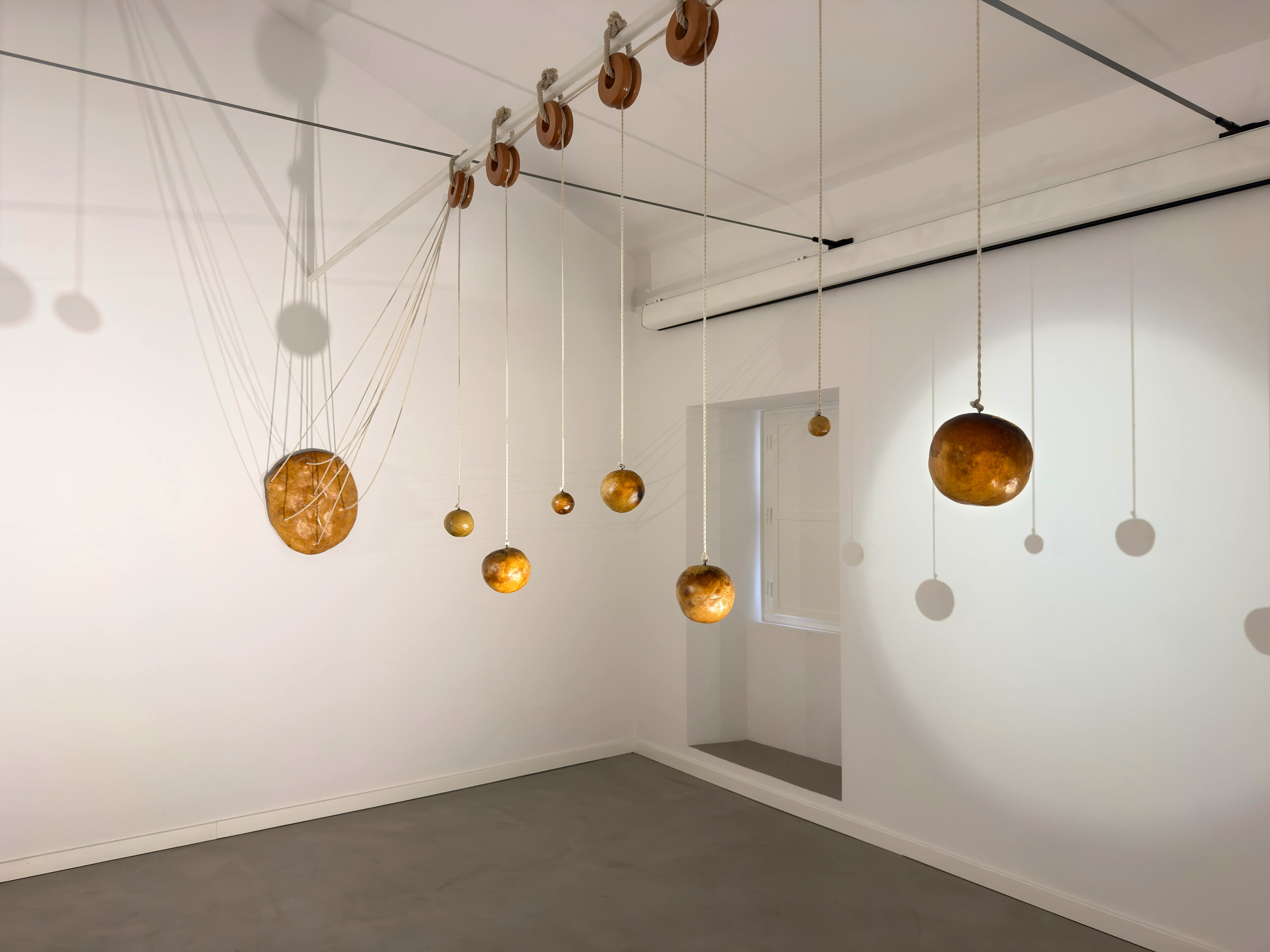
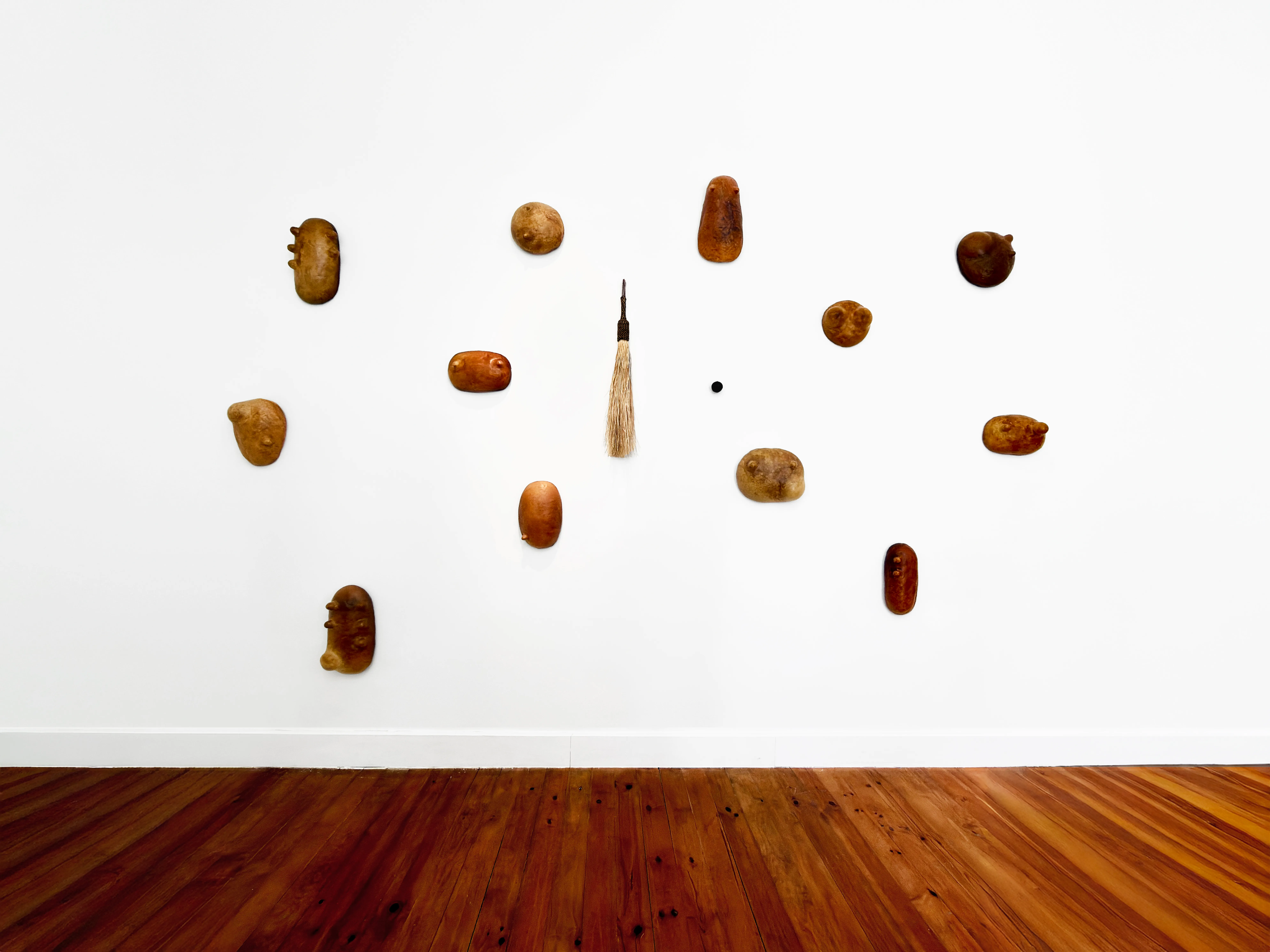
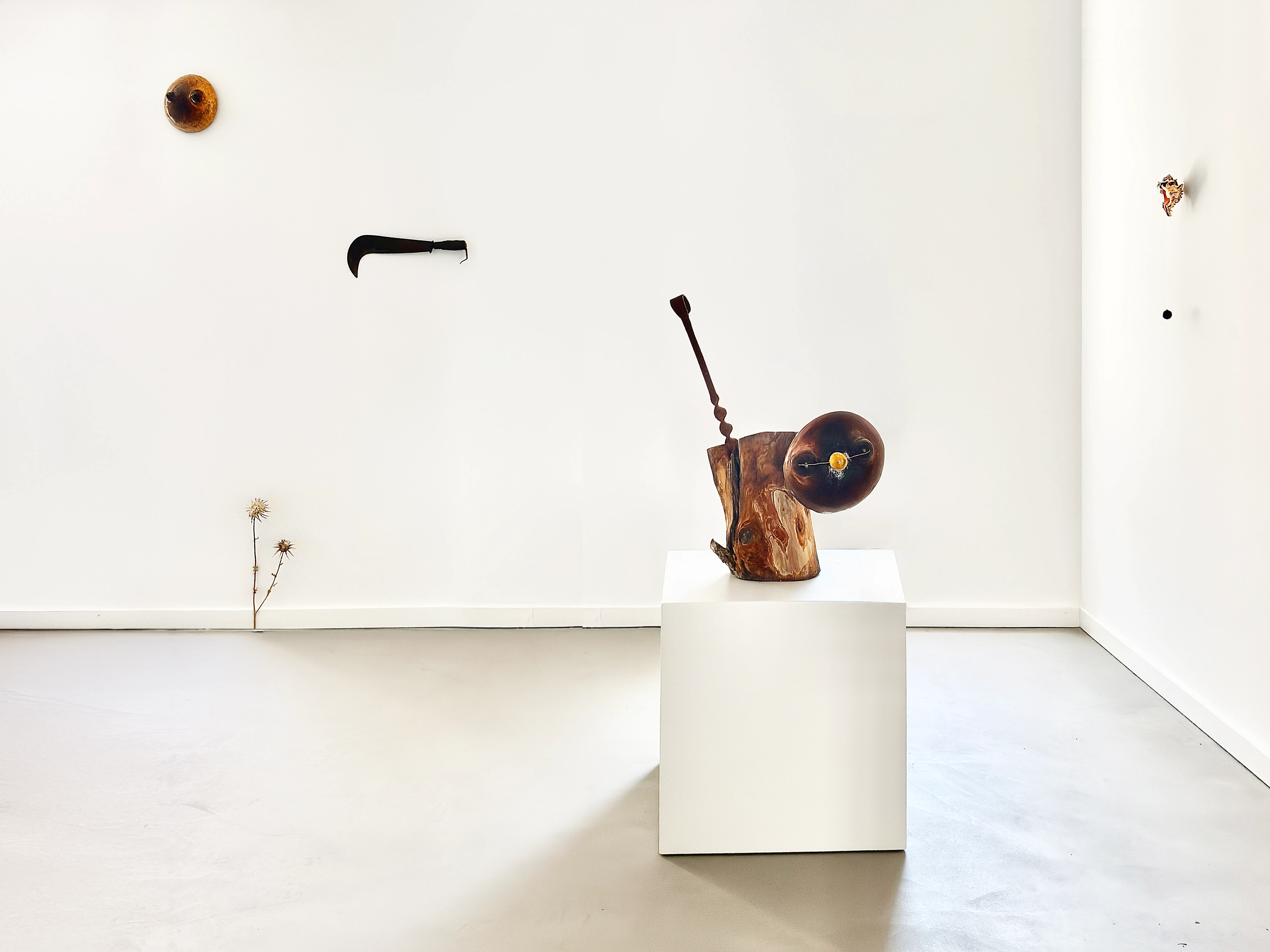
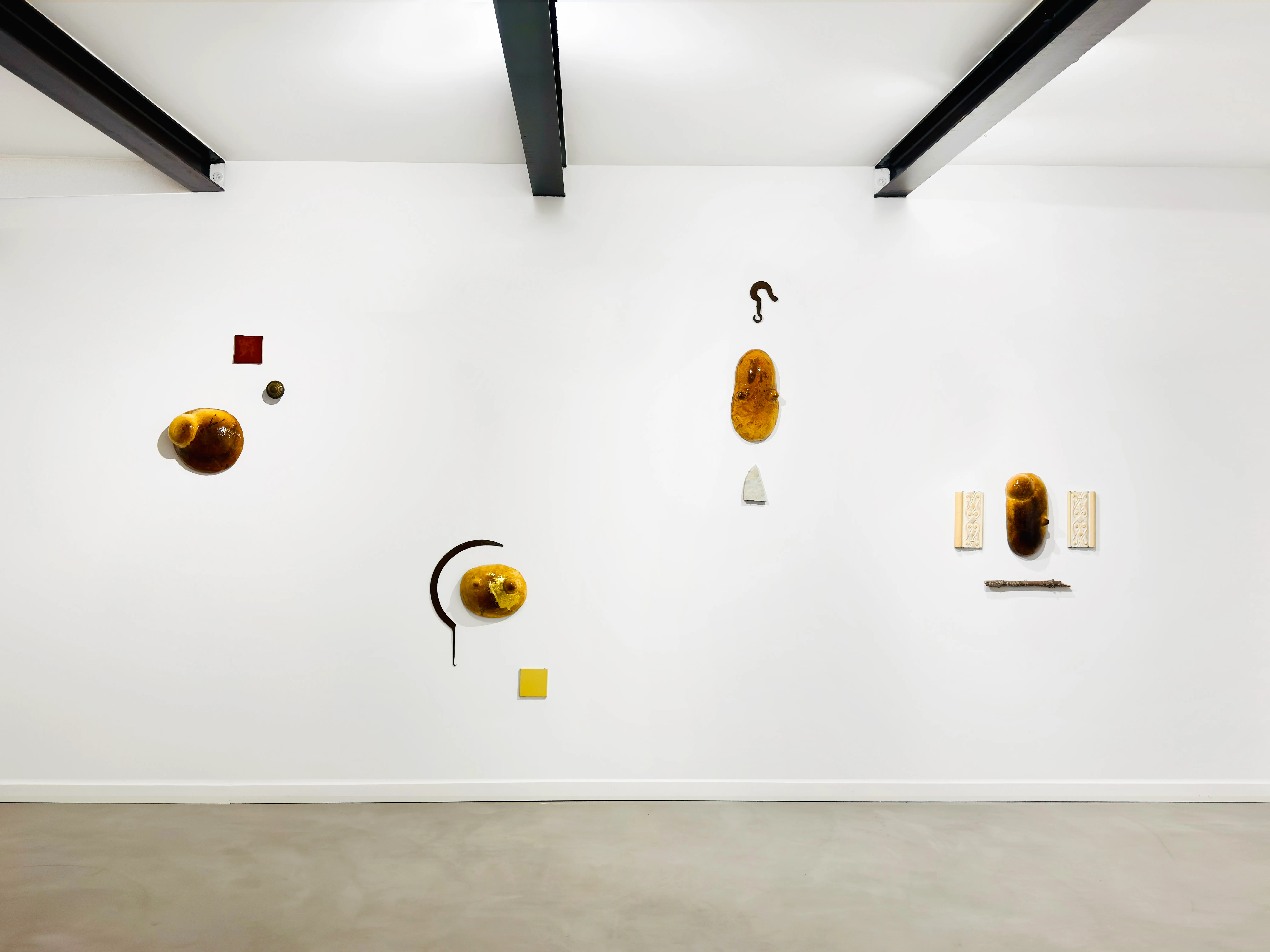
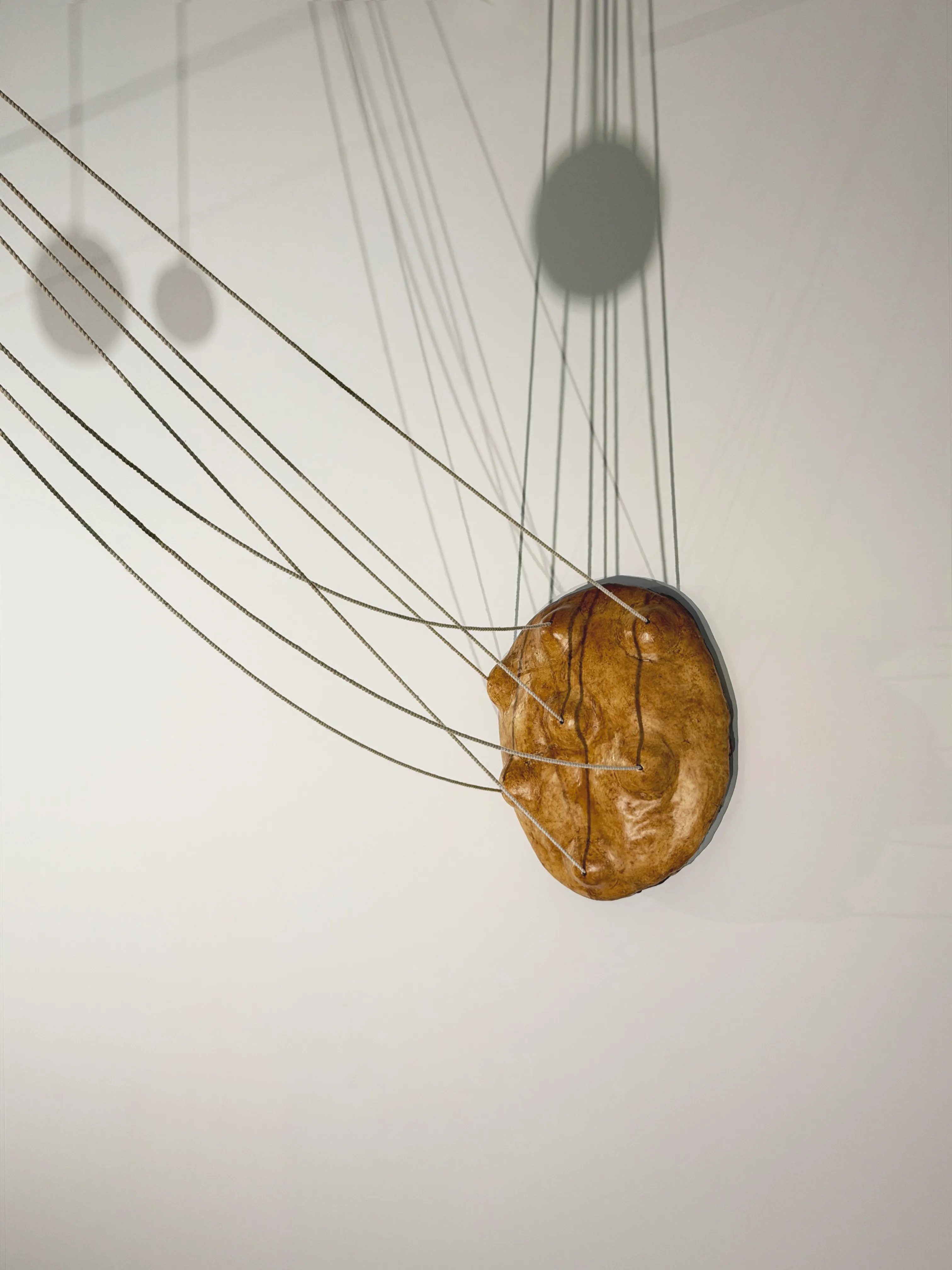
Θρῆνος belongs to Bake Your Pain, a project initiated by Kosmatopoulos in 2023 following the sudden death of her father. In moments of deep sorrow, she kneads bread dough and shapes a mask — a self-portrait, though not of her likeness. In these works, portraiture is progressively erased. Familiar features disappear until almost nothing remains but swollen forms where the eyes should be, as if the face had been reduced to the organs through which grief becomes visible.
These forms remain deliberately ambiguous. They can still be read as eyes, but also as breasts, wounds, tumours or anonymous flesh. The face begins to resemble a torso, collapsing the distinction between portrait and body. Mourning is no longer expressed through facial features alone; it appears inscribed in and upon the body, particularly the female body, where eyes, chest and flesh merge into a single anatomy of grief.
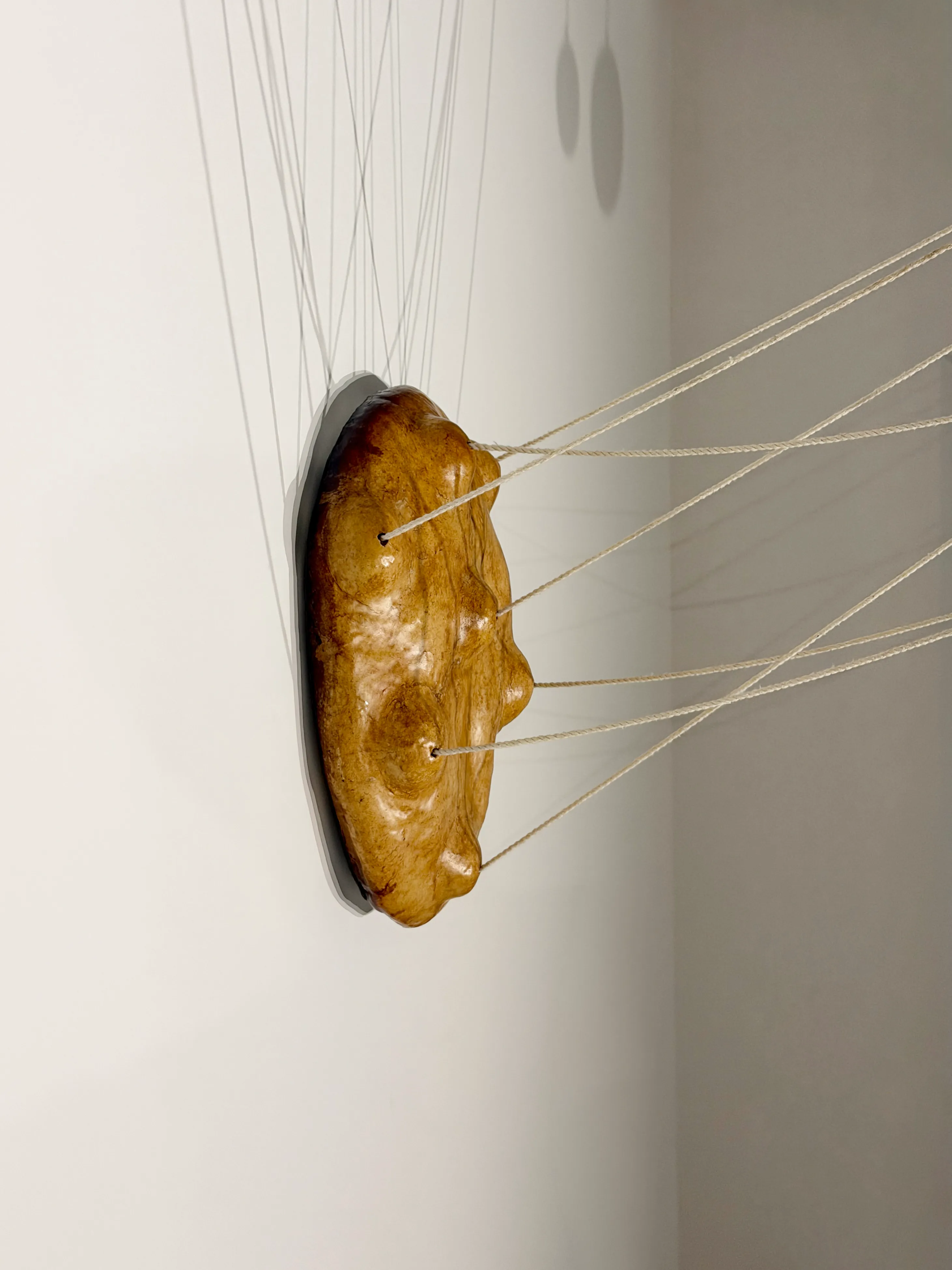
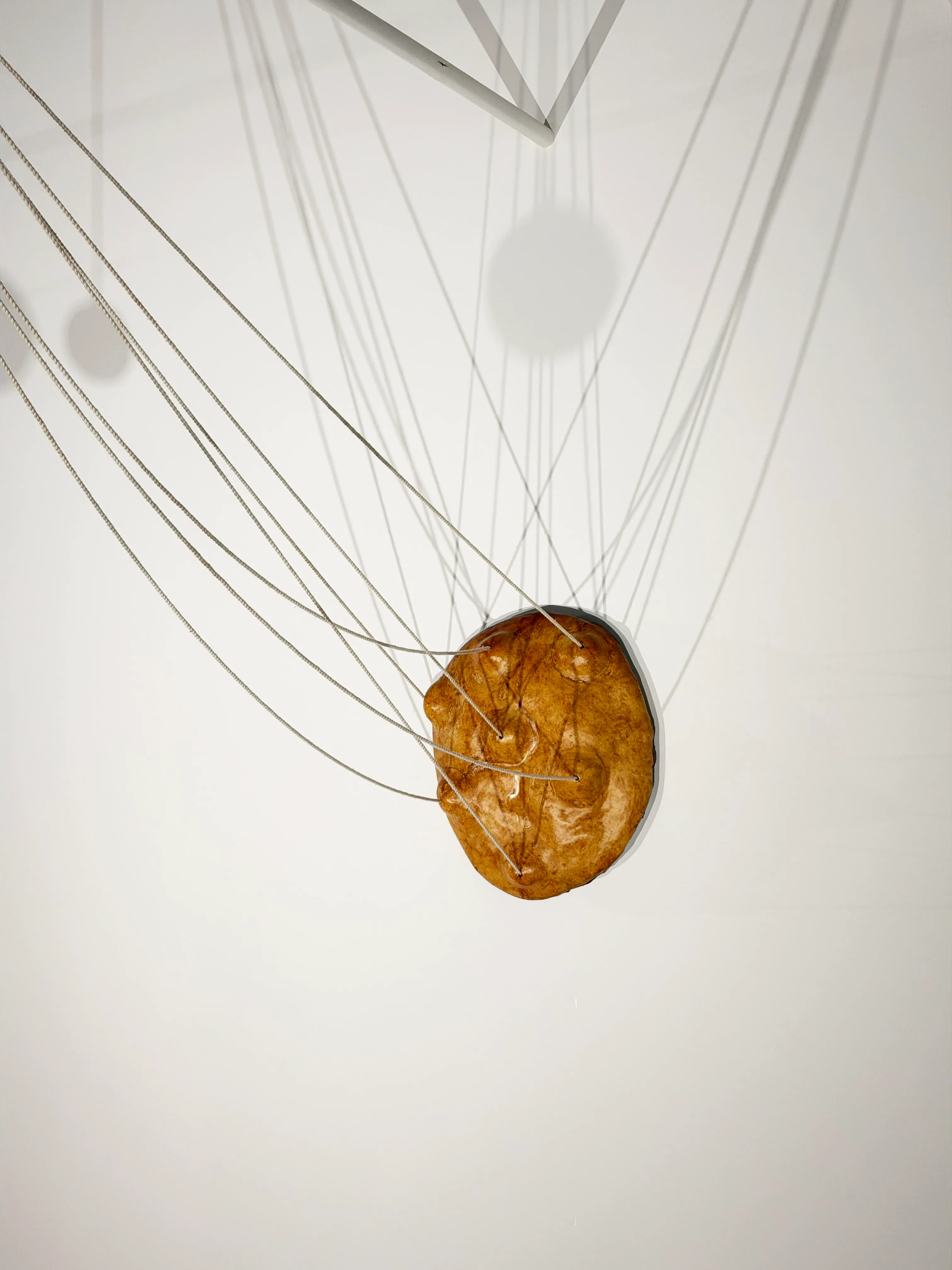
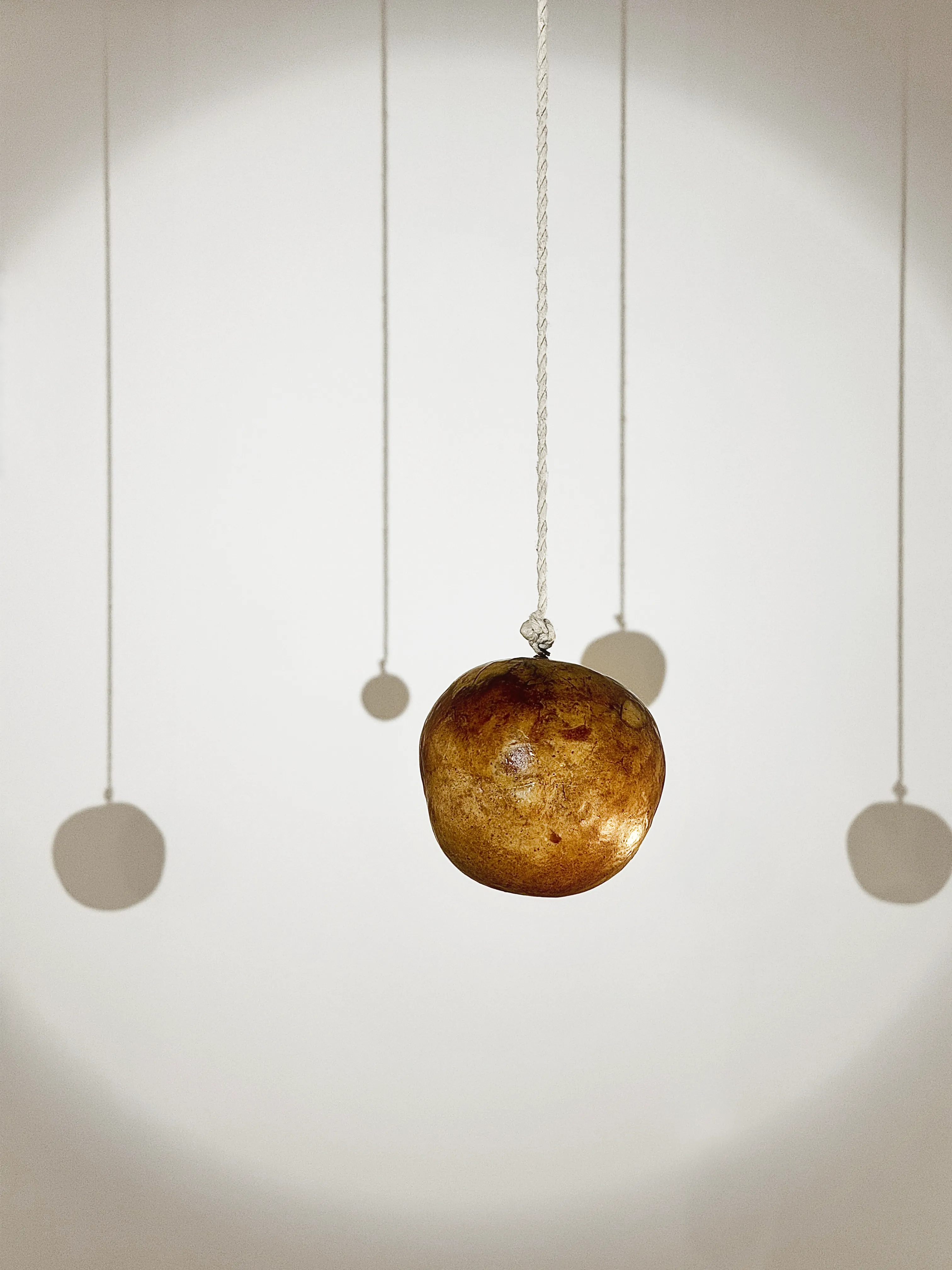
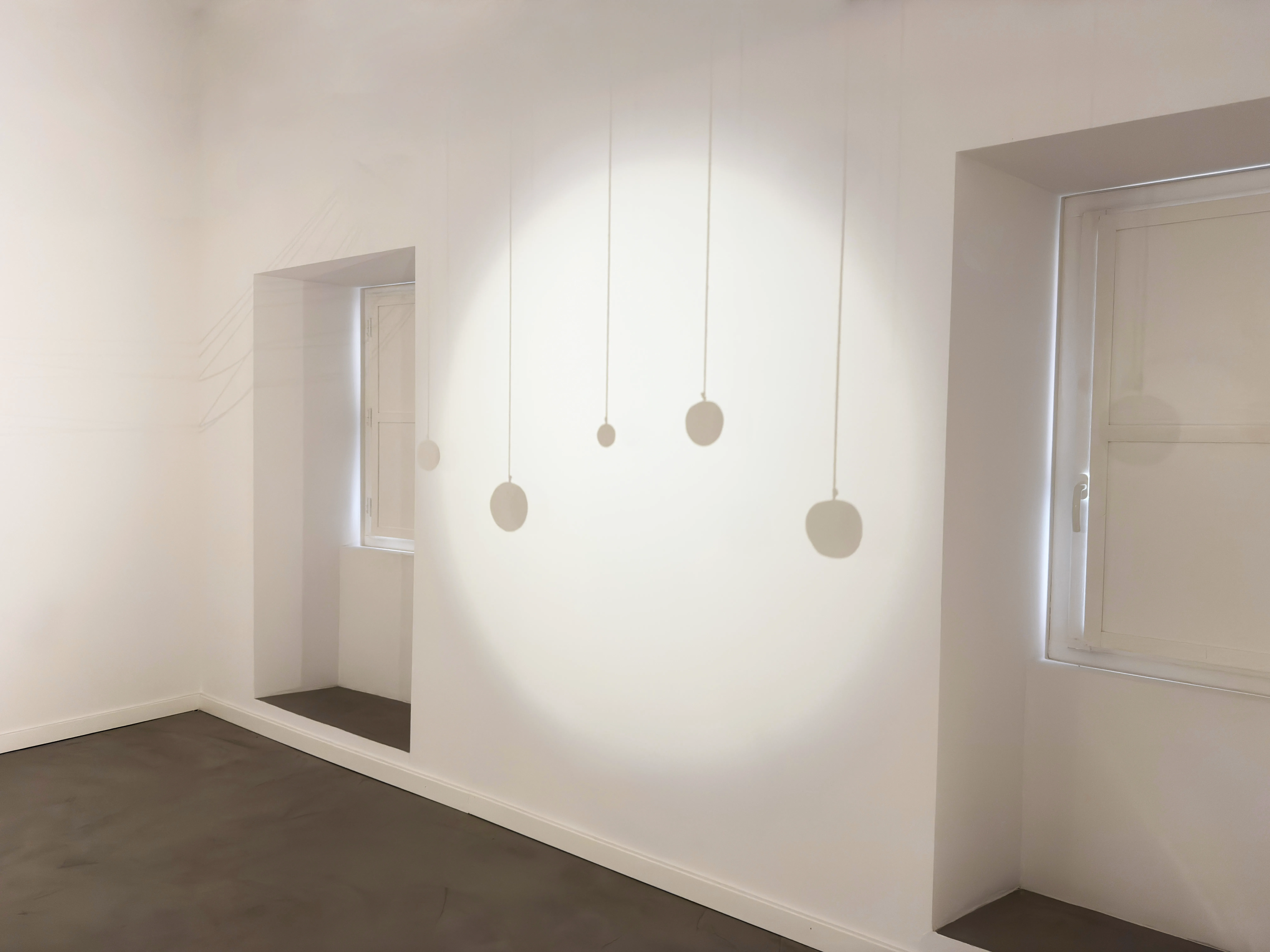
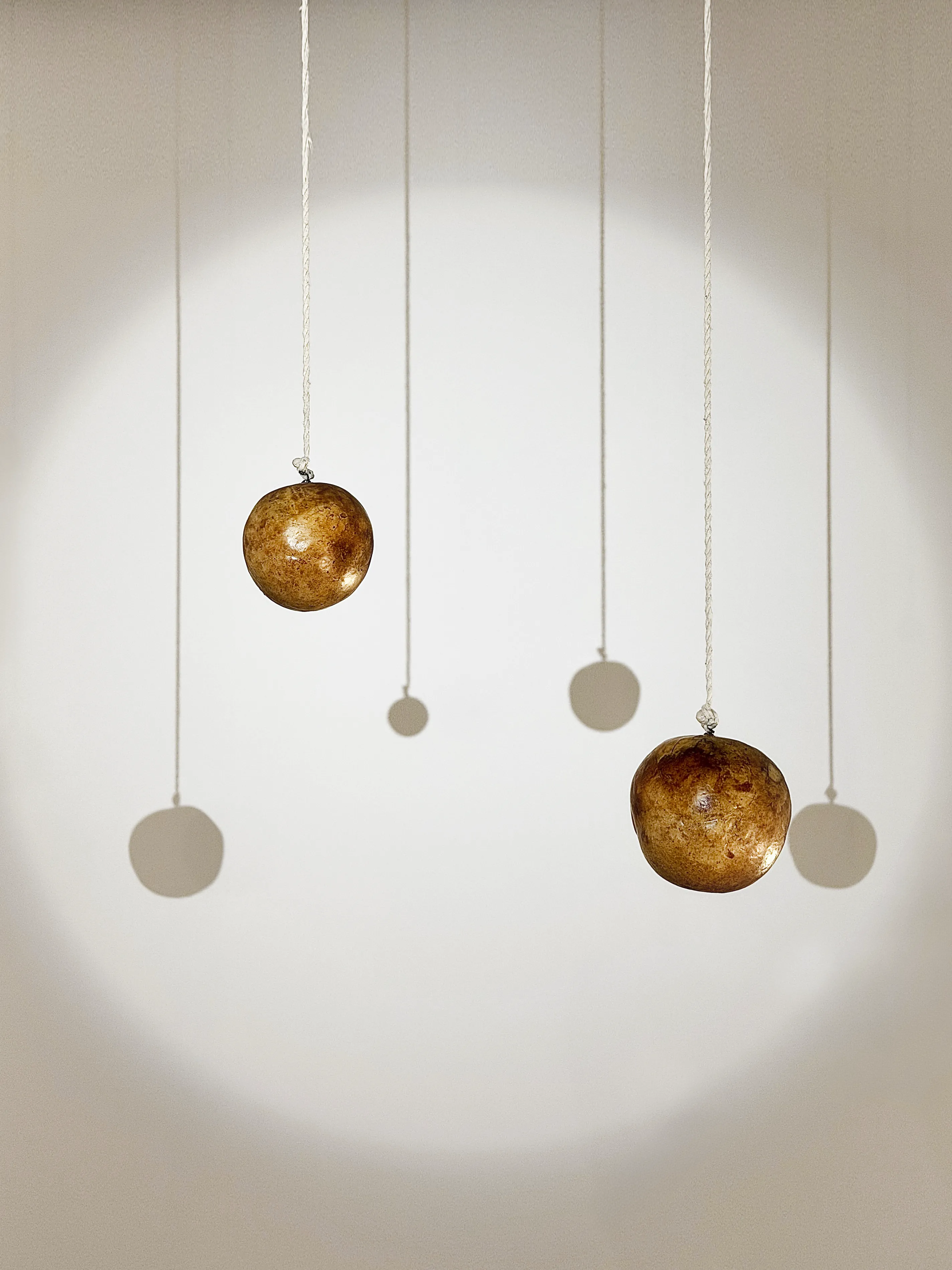
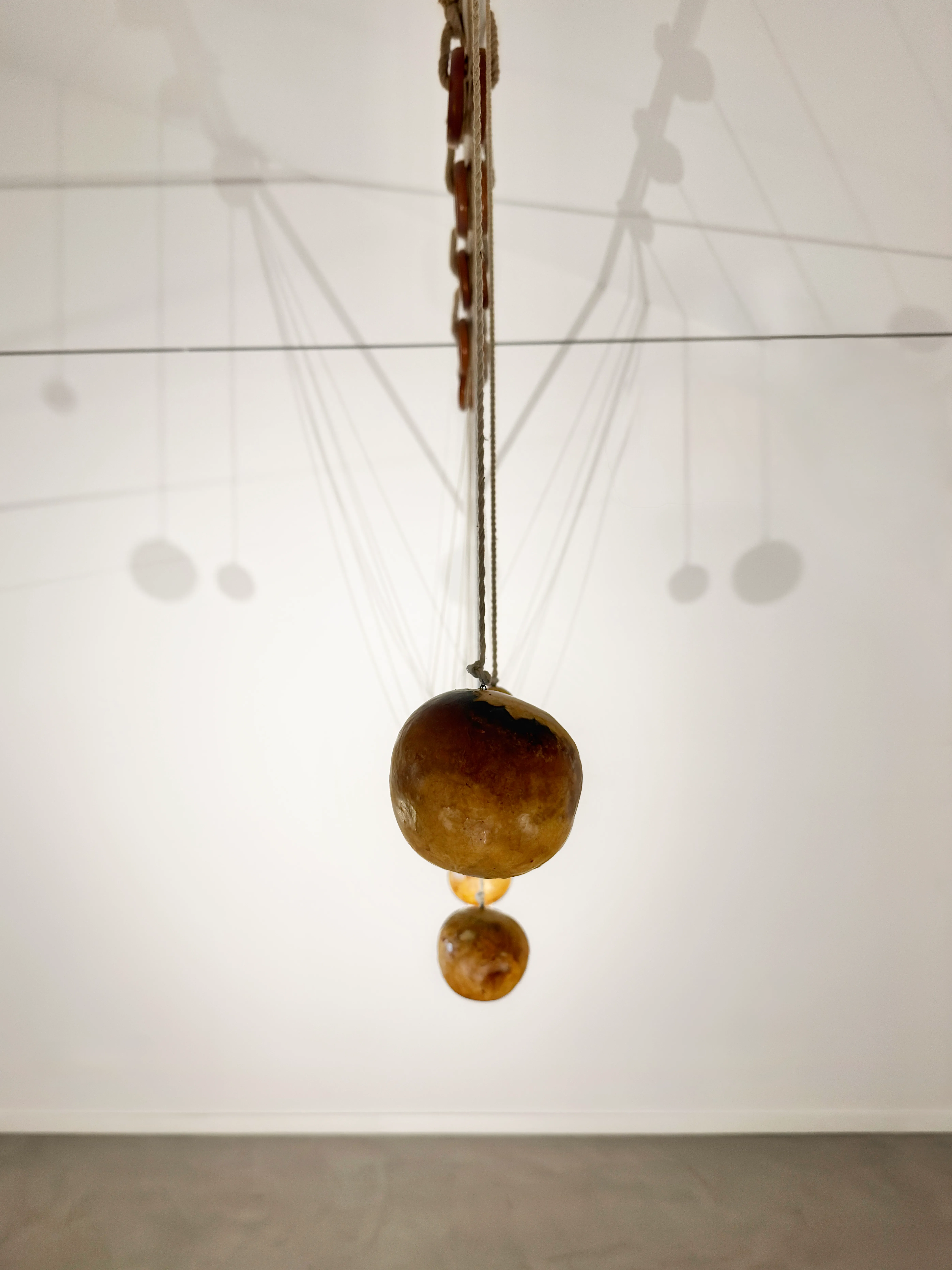
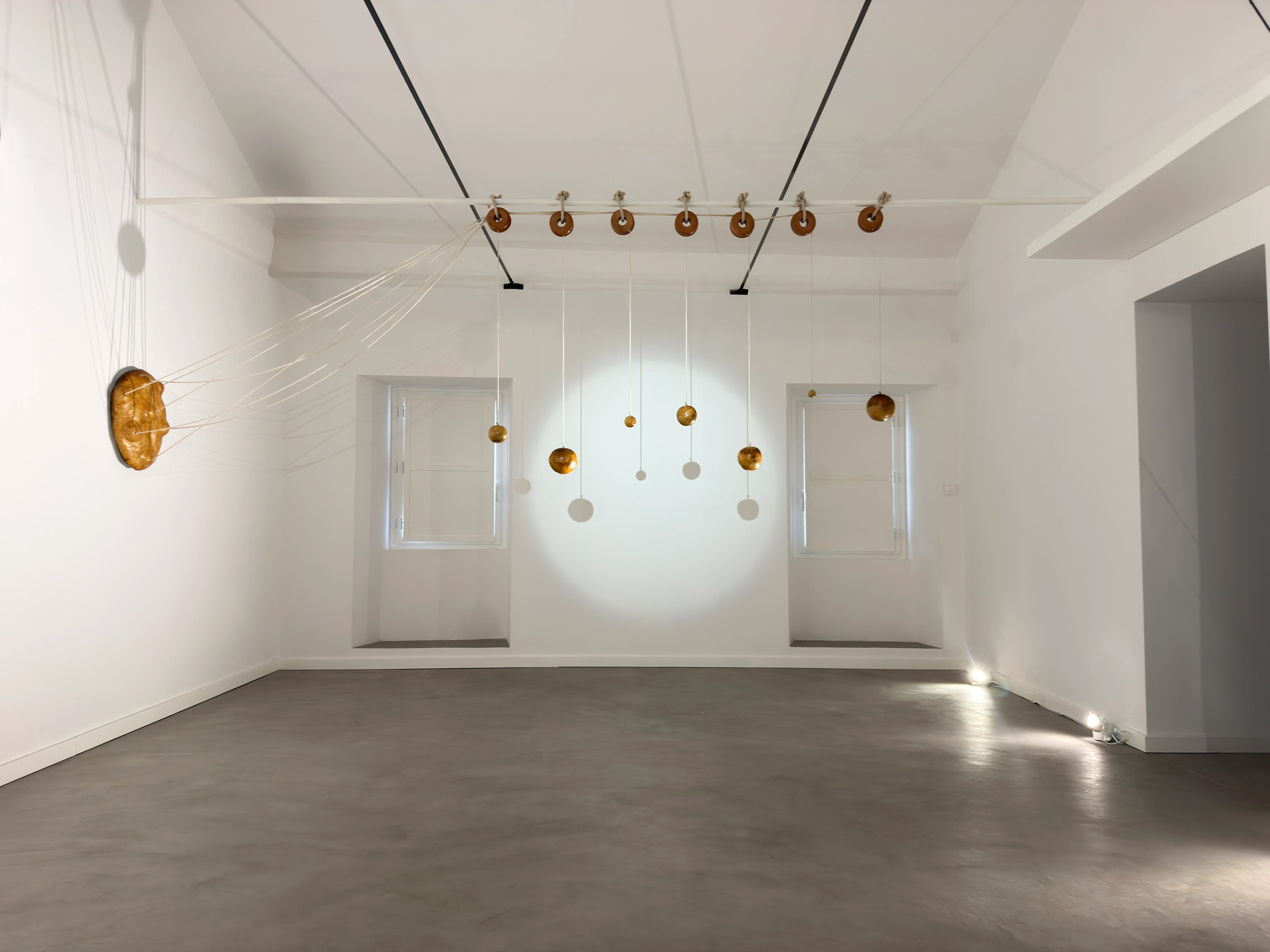
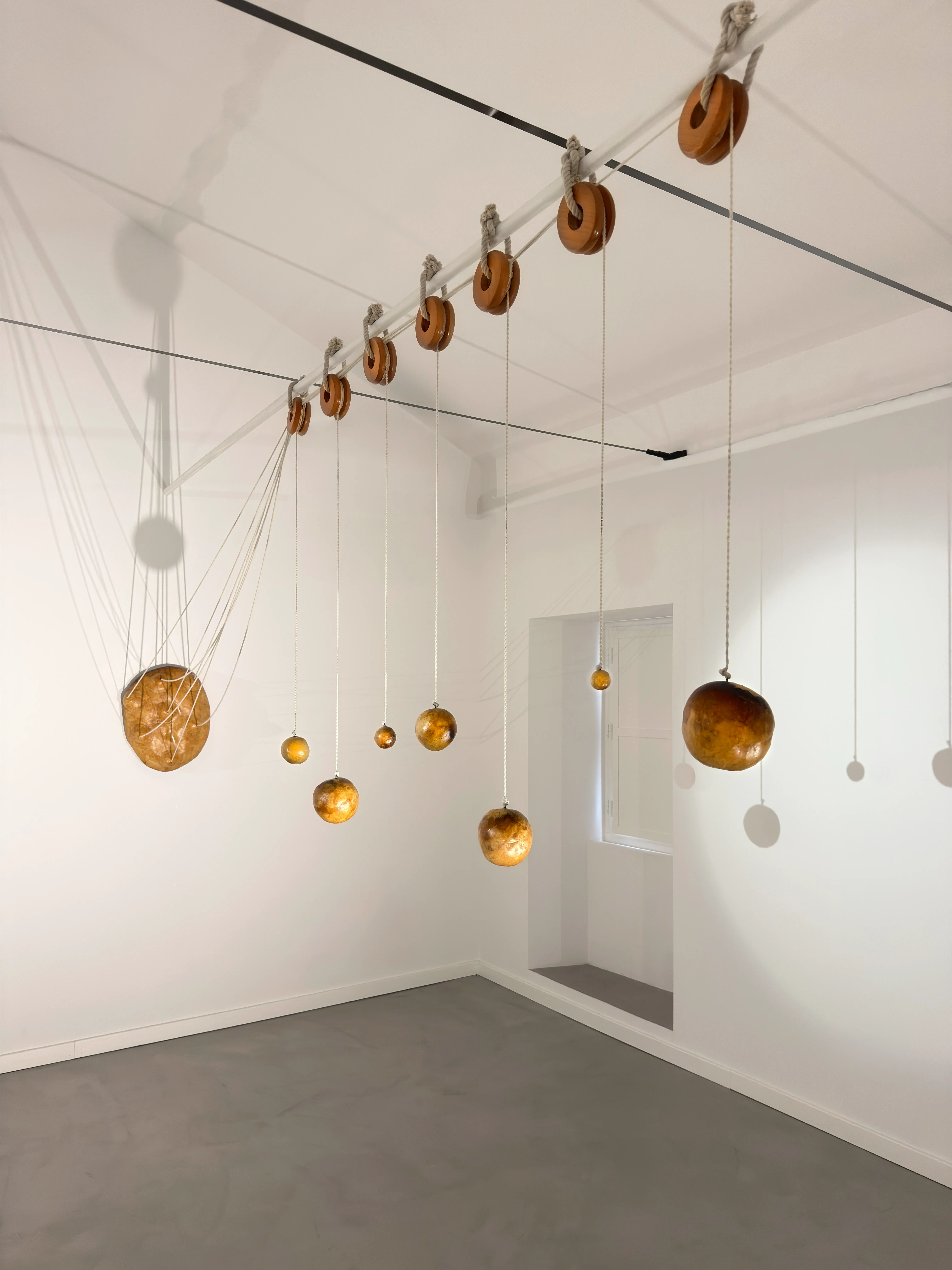
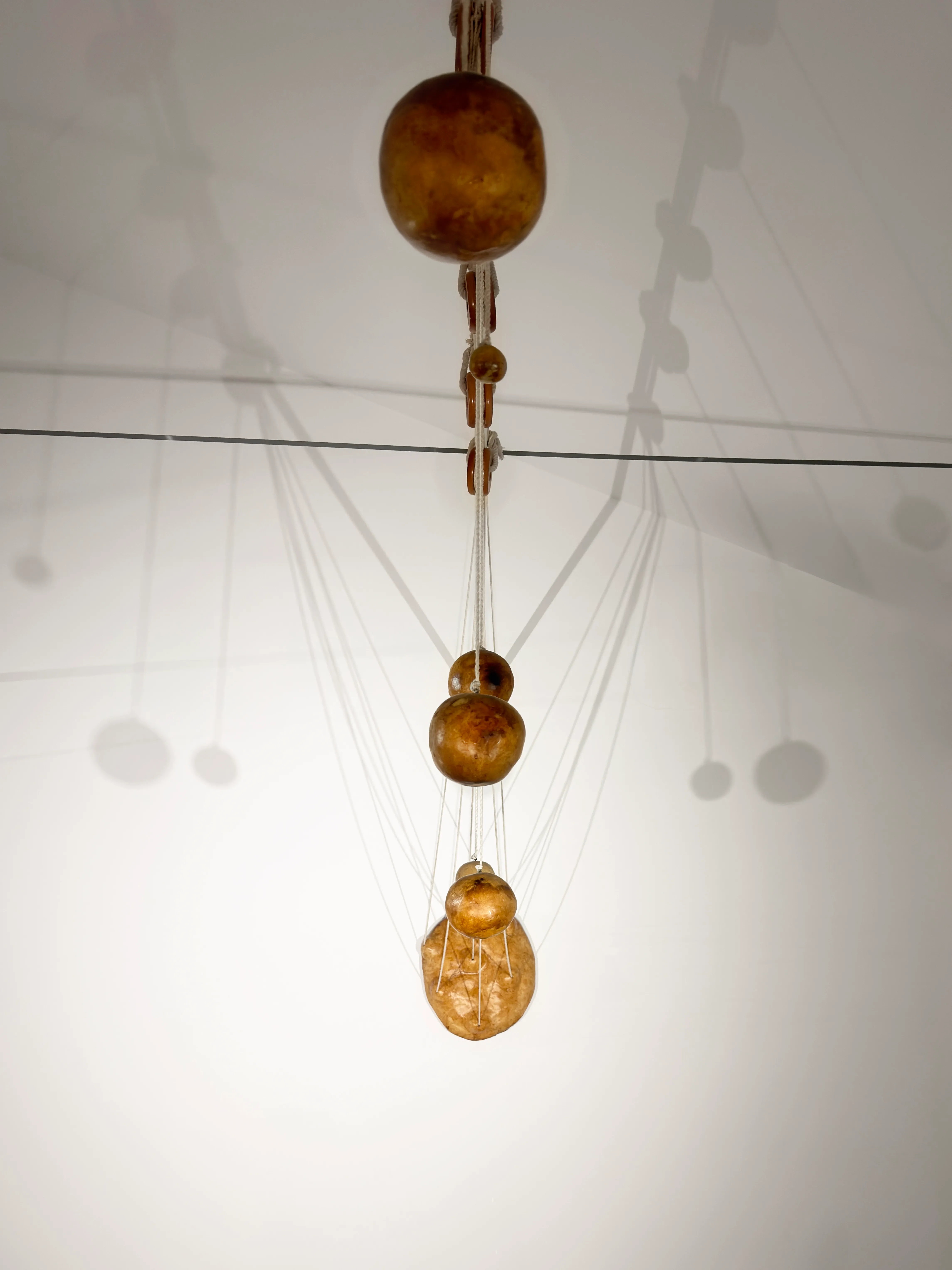
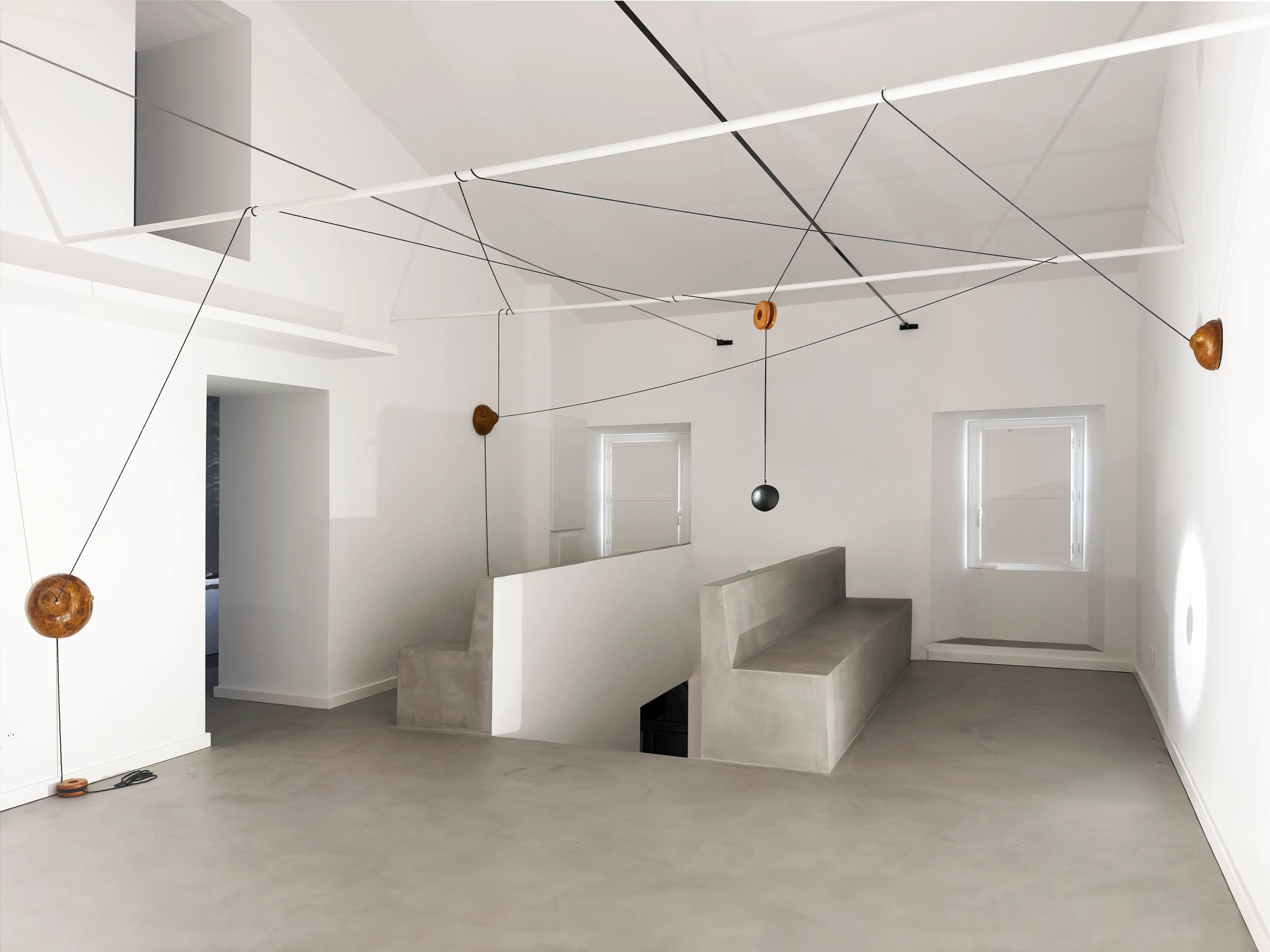
In Θρῆνος, the mask bears seven of these swollen forms. From them, cords extend outward like prolonged traces of tears, passing through pulleys before reaching seven spheres, also made of bread, of different sizes and weights. Each sphere gives physical form to a different phase, intensity or moment of grief.
These moments would ordinarily unfold through time. Here, they are condensed into a single face and made simultaneously present in space. What would normally be experienced successively is held together at once, as if time itself had been compressed within the body. The mask becomes a temporal field in which different moments of mourning coexist rather than follow one another in a fixed sequence.
The mechanical system extends this temporal compression into space. Cords rise from the mask, change direction through the pulleys and lead toward the bread spheres. At first glance, the structure borrows the visual language of gravity and mechanics: weight should pull downward, mass should determine position, and tension should respond predictably to force.
Yet the composition deliberately refuses this logic. The heaviest sphere is not necessarily the lowest, nor does the largest occupy the position that gravity alone might seem to demand. The spheres possess real mass, but the emotional weight they embody cannot be quantified. One moment of sorrow may feel overwhelming without being physically heavier than another; another may return unexpectedly after seeming to recede.
The arrangement also produces a rhythm. Cords rise, fall and change direction, while the seven bread spheres punctuate the composition at different heights, distances, scales and weights. The installation begins to resemble a musical score whose notation is made from tension, interval, mass and repetition rather than sound.
The title, Θρῆνος — lament — evokes a form through which grief is given rhythm and structure without being overcome. Here, the lament remains silent. Time is condensed into a face; emotional weight becomes physical form; and the mechanics of mourning become a score written across space.
Θρῆνος gives form to what can be carried but never weighed.