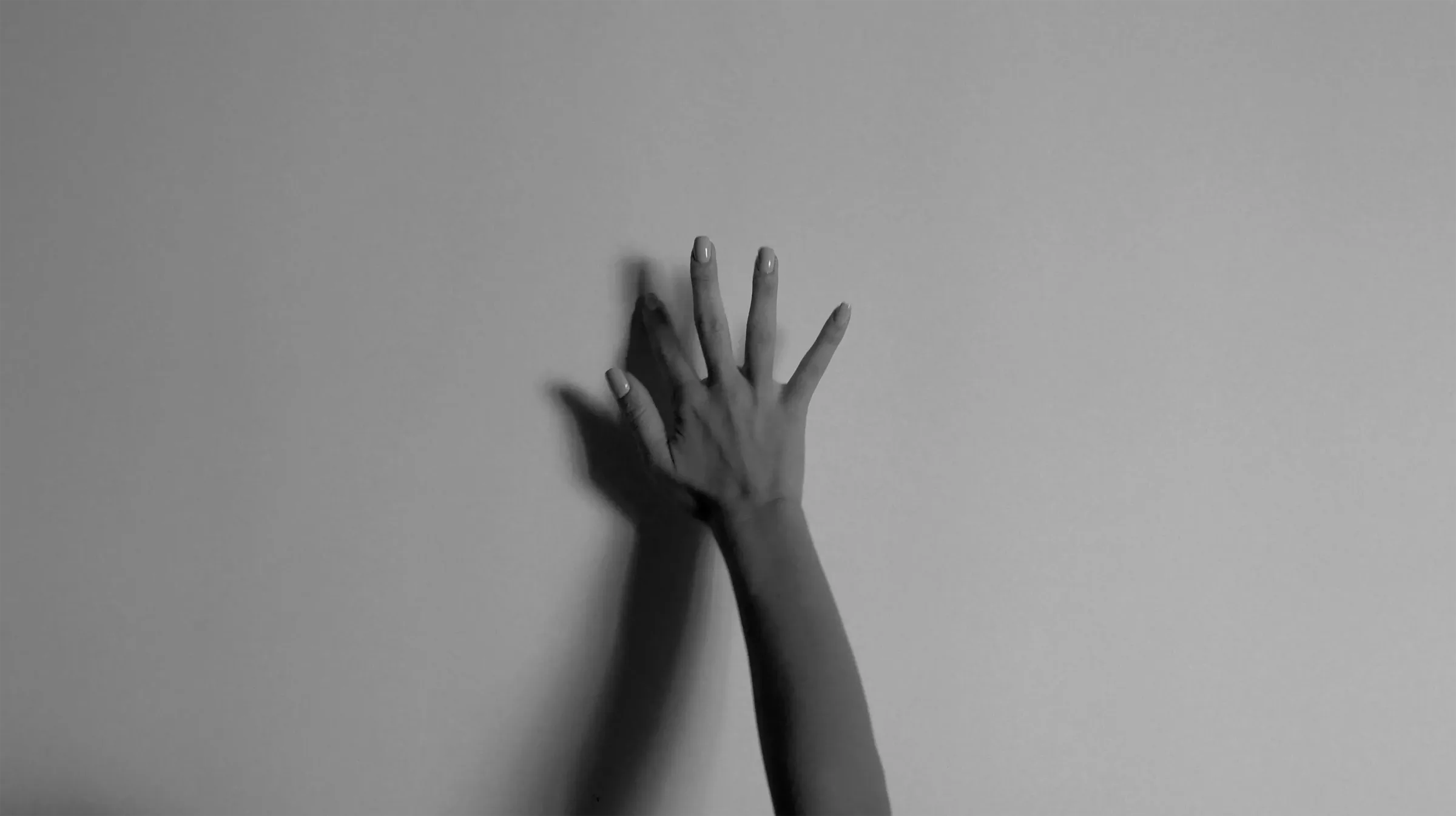
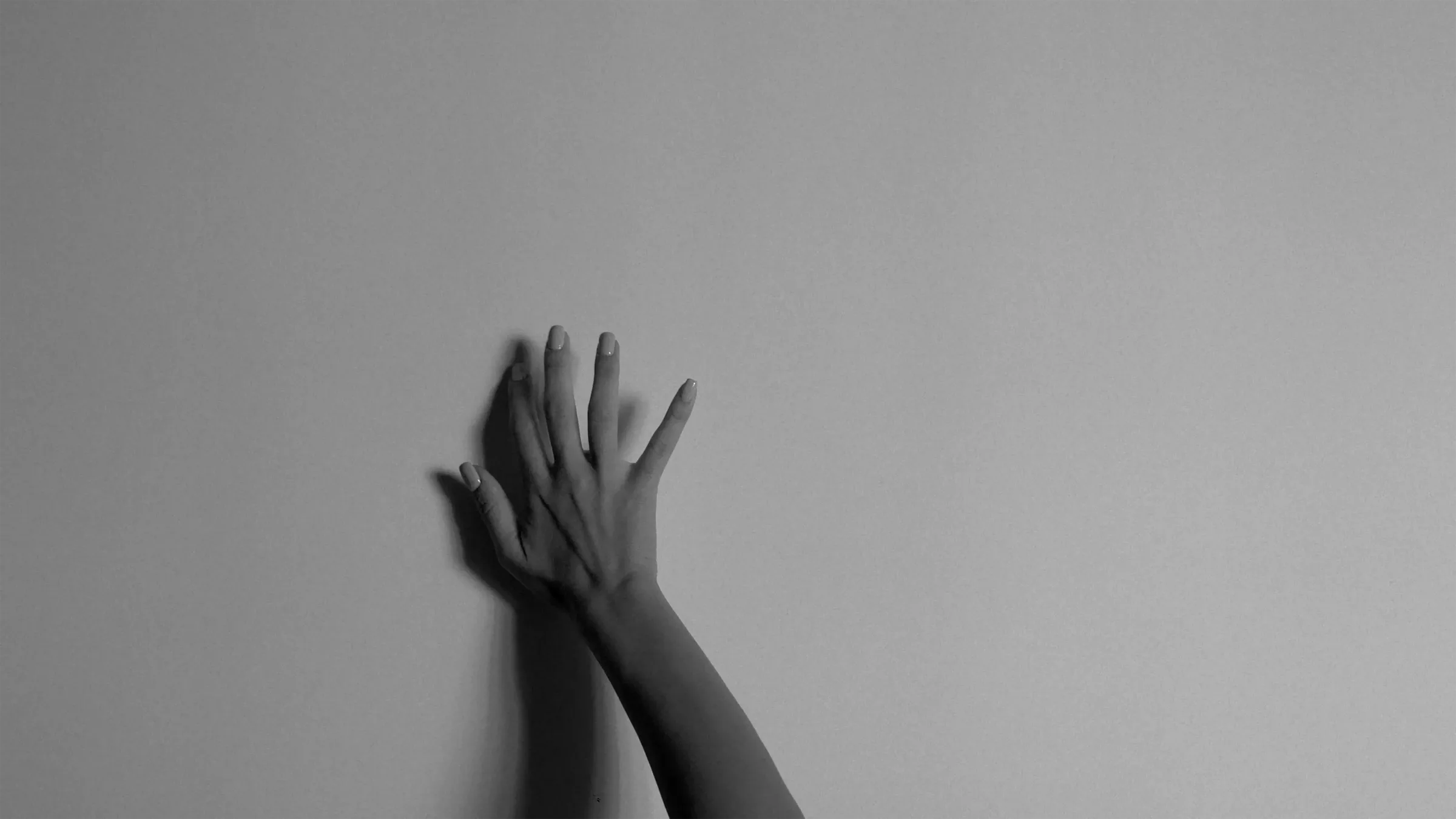
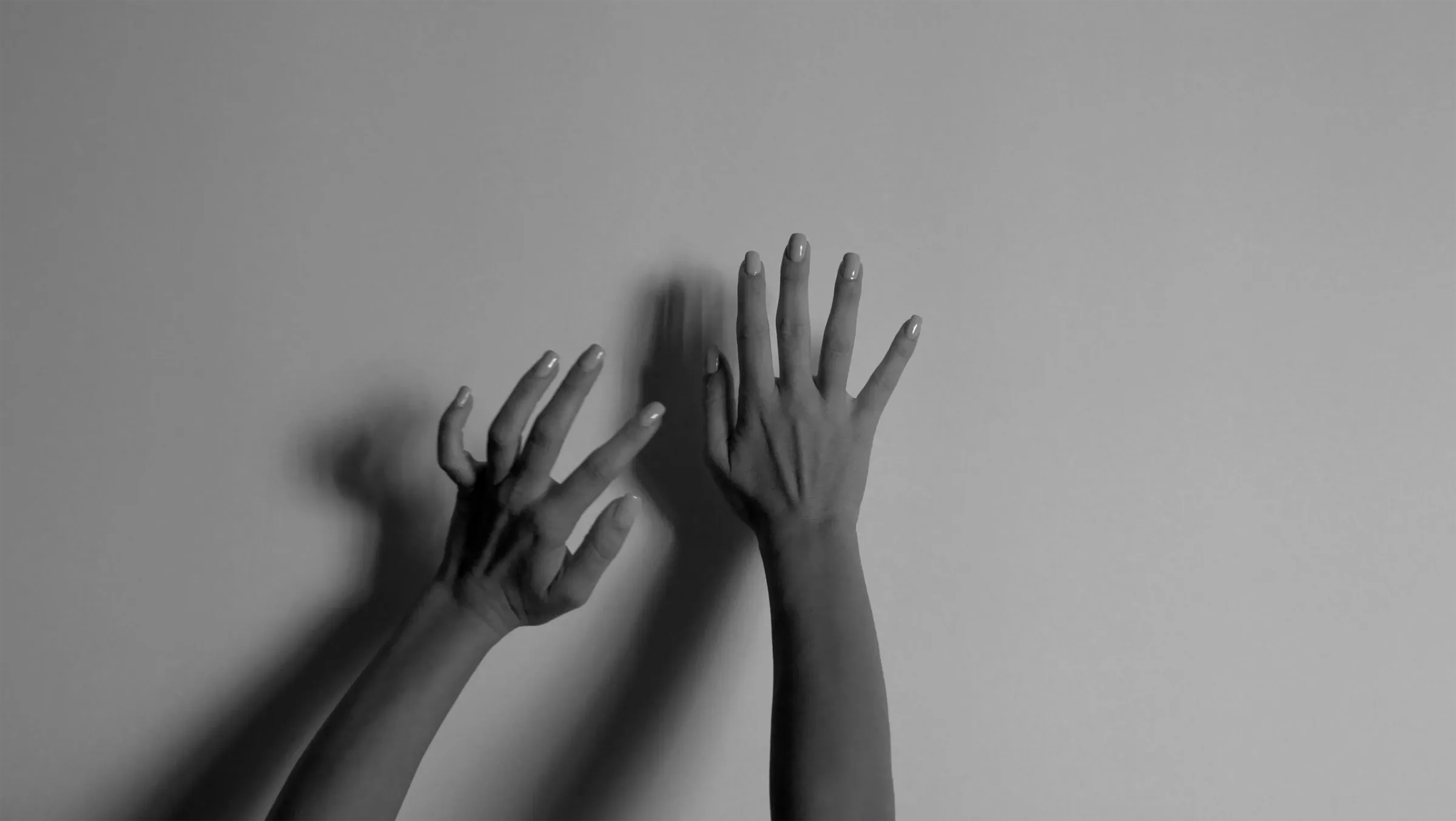
The video opens on a black screen and a single line: Parfois, je cherche à toucher mon ombre (Sometimes, I try to touch my shadow). Then comes a pale grey wall, lit from one side, and a forearm rising into the frame from below. Filmed in a fixed frame, without sound, the hand presses its palm to the plaster, spreads its fingers, closes them, withdraws and returns. Each movement is doubled by a shadow that falls across the wall at an angle, longer and softer than the arm that casts it.
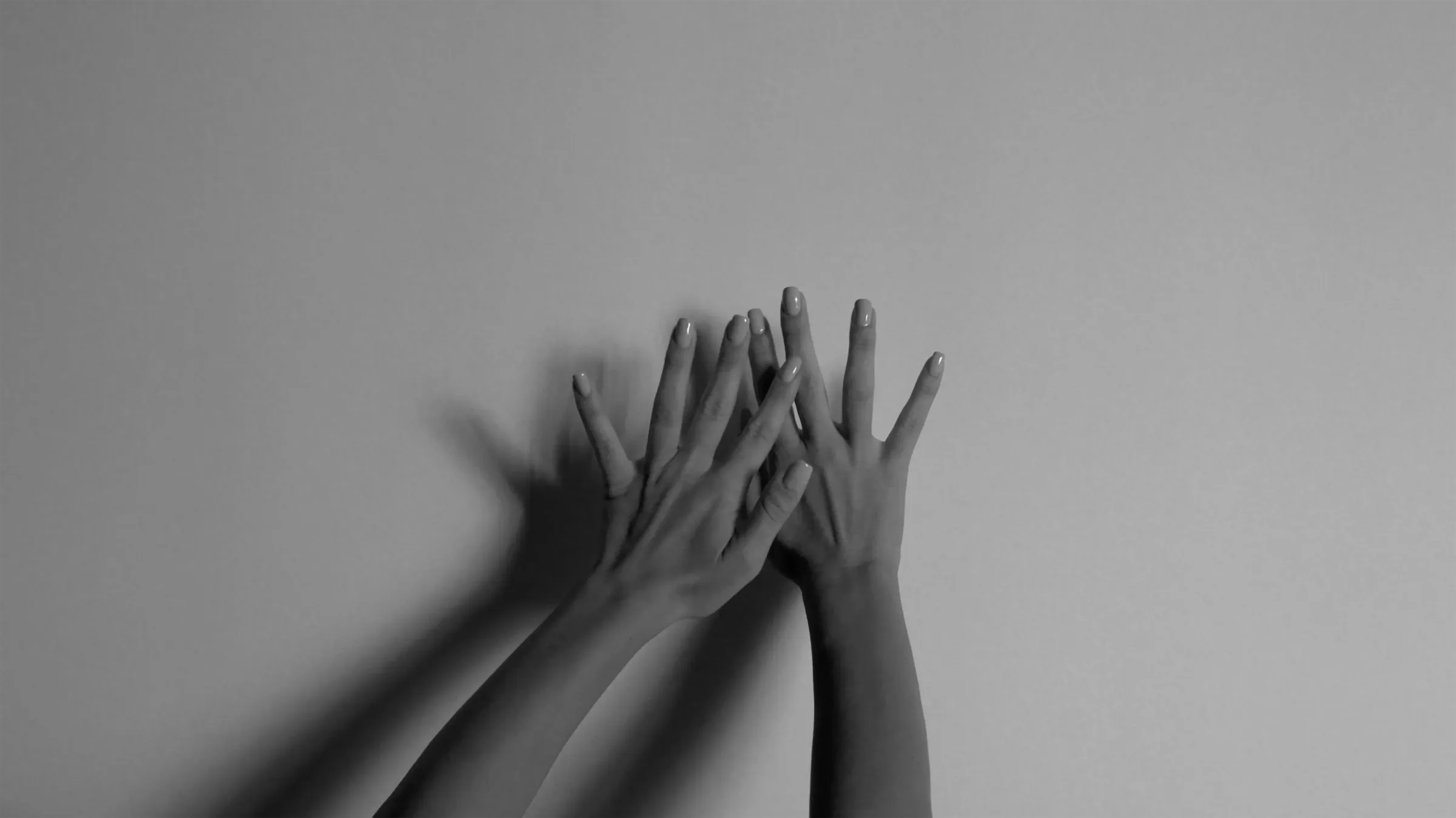
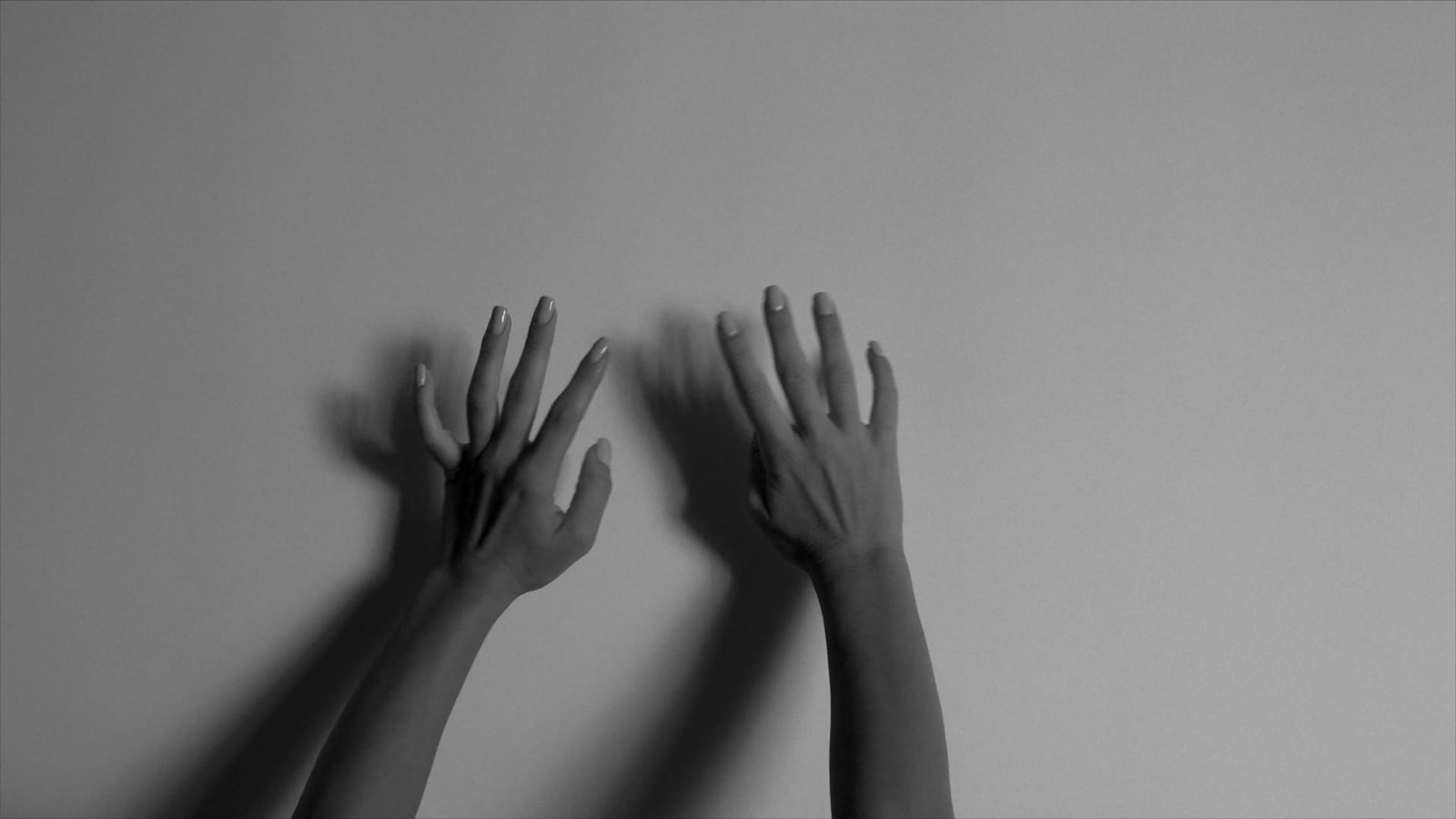
Hand and shadow approach each other without ever quite meeting. When the fingers lie flat against the wall, the shadow joins them at the fingertips and nowhere else; when the arm draws back, the shadow stretches, blurs and slips out of reach. At times the hand leaves the frame altogether and the wall stays empty, as if waiting. Past the middle of the video, the sentence is completed: pour voir si j’existe toujours (to see if I still exist). In the last part, two hands share the wall, and their shadows cross, overlap and separate in turn.
Dans Caressing Walls, the work turns Maurice Merleau-Ponty’s touching-touched hand inside out. When one hand touches the other, it feels itself being felt. Touch is reversible, and through that reversibility the body knows that it exists. The shadow offers no such answer. It is the one part of the body the hand can reach and never feel. The palm meets only plaster, cool and indifferent, and the shadow, which follows every gesture exactly, has no skin with which to touch back. The caress goes out towards the self and comes back as a surface.
The wall is therefore both obstacle and condition. Without it, the shadow would have nowhere to fall; with it, the hand can never pass beyond. The boundary that the project locates in the skin is projected here outside the body, onto architecture, as a dark outline that belongs to the artist without being her.
The shadow also holds another figure. It comes from the body yet precedes it, follows it and sometimes moves ahead of it, larger than the arm that casts it. In this relationship Kosmatopoulos reads the bond between mother and daughter: a form inherited before it is chosen, a femininity received as an outline that one inhabits, imitates and resists. The hand that tries to touch its shadow is also a daughter measuring herself against what was passed down to her, testing where the mother’s contour ends and her own begins.
The video never lets the two coincide. Each time the fingers settle on the wall, the shadow is already shifting with the light. What remains is the attempt itself, repeated with patience: a body reaching for the trace it leaves, to find out, in the gap between them, whether it is still there.